

Many rooftops are perfect for solar but owners and renters can’t afford it. Here’s our answer
- Written by The Conversation
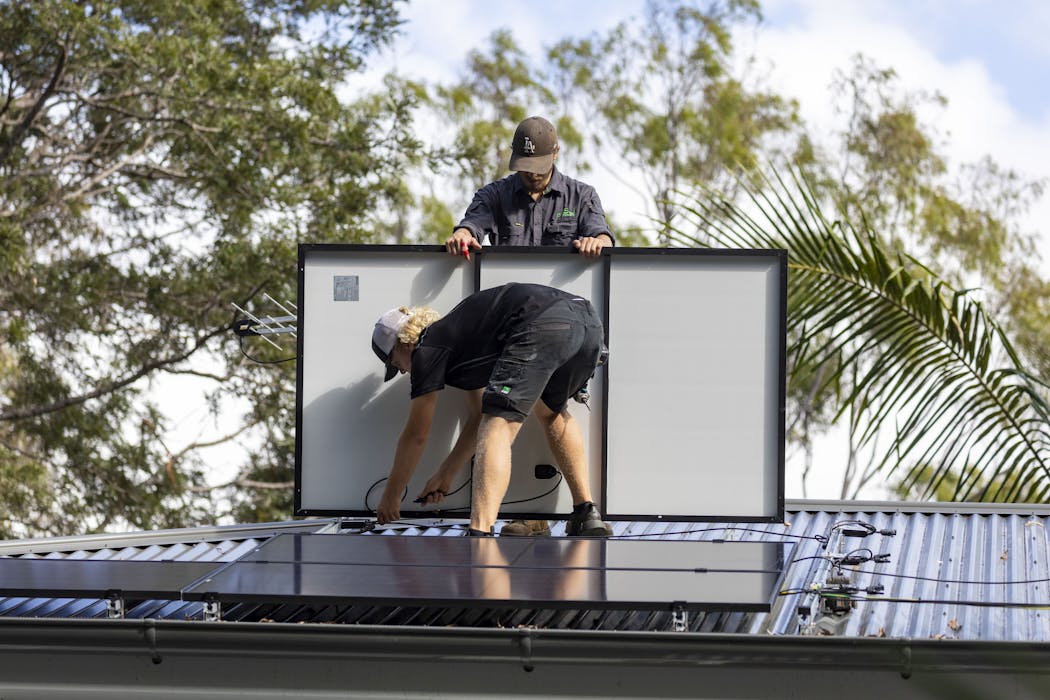
Australians love rooftop solar power. About 4 million homes have solar panels on their roofs, and we generate more solar energy per person than any other country.
But affordability pressures on home owners are holding them back from installing rooftop solar on millions of homes. Without this, Australia could struggle to meet its goal of generating more than 80% of electricity) from renewables by 2030.
We propose a bold new “use it or lend it” solar program, under which the owners of detached and semi-detached homes would have the option of allowing the government to install and operate solar panels on their rooftops.
This could be an effective alternative to traditional energy rebates to accelerate the energy transition. And the electricity generated from these systems could be allocated to low-income households and renters, who are currently unable to access solar power.

Boosting solar
Slightly more than half of owner-occupied houses in Australia have solar panels.
Our new research looked at the factors that influenced household solar panel uptake in the Sydney metropolitan area from 2013 to 2024.
We found that as the cost of panels and batteries dropped over time and electricity prices soared, more homeowners decided to install solar. In contrast, the feed-in tariffs – the payment from electricity retailers for surplus electricity you put back into the grid – seem to have little impact on solar adoption.
Perhaps unsurprisingly, we found that high house prices relative to household incomes resulted in reduced solar adoption, showing housing affordability is a barrier for solar uptake. Despite the long-term savings offered by solar, home owners battling housing affordability simply didn’t have as much disposable income to spend on solar panels.
At present, a typical 6.6 kilowatt system costs about $8,500, but the owner only pays about $6,200 because of the Commonwealth Small-Scale Renewable Energy Scheme rebate. These rebates are being phased out by 2030.
Untapped potential
Australia has a legislated greenhouse emissions target of 43% below 2005 levels by 2030 and net zero by 2050. Last month, it announced a more ambitious interim target of 62–70% below 2005 levels by 2035.
To meet this goal, we will need to generate more than 80% of Australia’s electricity from renewables by 2030. We are not yet on track.
To overcome the shortfall on solar adoption, bold policies are needed to make rooftop solar accessible to all households, not just those who can already afford it.
What has been proposed so far? The Climate Council advocates for the mandatory inclusion of solar on new and substantially renovated houses, as well as suitable new apartment buildings. The Grattan Institute says state and territory governments should provide certainty with a long-term date for the end of gas.
But these approaches take time. We propose a third and complementary “use it or lend it” option. Under this scheme, owners of detached and semi-detached houses that have not installed solar could “lend” their rooftop space to the government for publicly owned solar panels.

How ‘use it or lend it’ would work
Owners who chose this option would retain full ownership of their property while receiving compensation, such as annual lease payments, for allowing public use of their rooftop space.
This arrangement would give property owners the clear, risk-free benefit of financial compensation without the cost of installation or responsibility for maintenance of the panels themselves. We expect the program would appeal to low-income homeowners who cannot afford solar panels, as well as rental property owners who may be reluctant or unable to invest in solar.
For the government, the electricity from these systems could be allocated to low-income households and renters, two groups that face the greatest barriers to direct solar participation. This could be done through [virtual energy networks], a digital platform that allows solar households to sell excess electricity to non-solar households. The “use it or lend it” policy could be an effective tool to address equity concerns in solar uptake.
Property owners could choose to buy back the rooftop solar panel system installed by the government at any time. If existing owners initially opt out but later wish to opt back in, or if new property owners decide to participate, the purchase price would be determined based on the “cost neutrality” principle, meaning the government does not profit.
To ensure feasibility and fairness, the program would have to include safeguards covering roof integrity and owner indemnity against potential damage or injury. It would need fair access principles for the installation, service and removal of the solar panels and batteries.
Each property’s solar suitability would be assessed by accredited professionals, considering technical viability as well as the property owner’s priorities, for example planned subdivisions or renovations.
With only five years until the current solar rebates are phased out, now is the time to consider how to boost solar installation without them.
With careful design and drafting, a landowner lending their roof space to the government does not disadvantage them. Owners, renters, the government and the climate would all benefit from solar panels on unused roofs.


