

Government reveals taxpayer-funded deal to keep Australia’s largest aluminium smelter open. How long we will pay?
- Written by The Conversation
It seemed inevitable – politically at least – that the federal government would step in to save Tomago Aluminium in New South Wales, Australia’s largest aluminium smelter.
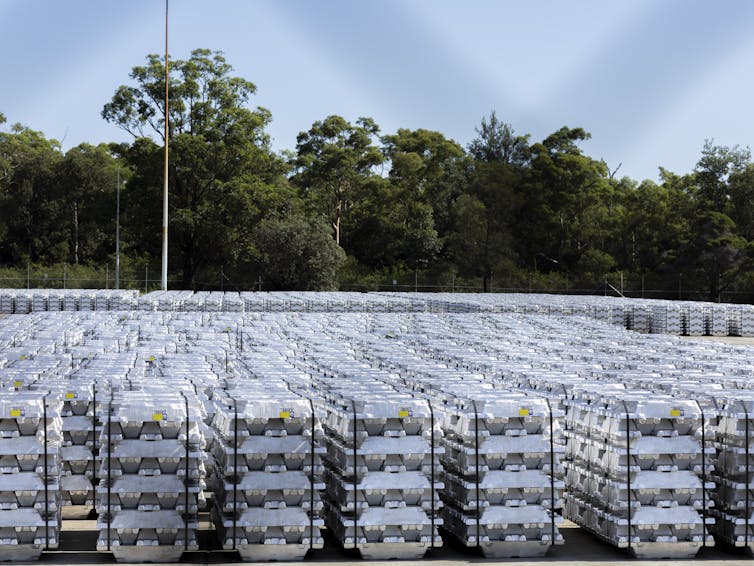
Rio Tinto, the owners of Tomago, has enjoyed attractively priced electricity for a long time, most recently with AGL. But this contract ends in 2028. Unable to find a replacement at a price it could accept, Rio Tinto warned that Tomago was facing closure. Tomago produces more than one-third of Australia’s aluminium and accounts for 12% of NSW’s energy consumption.
On Friday, Prime Minister Anthony Albanese announced a Commonwealth-led deal for electricity supply beyond 2028. This deal will provide the smelter with billions of dollars in subsidised power from the Commonwealth-owned Snowy Hydro through a portfolio of renewables, backed by storage and gas. This follows months of negotiation to avoid the smelter closing and sacking its roughly 1,000 workers.
The government has provided funding to support other struggling manufacturers such as the Whyalla steelworks and the Mount Isa copper smelter, and wants to see aluminium production continue in Australia. About 30–40% of the cost of making aluminium is the energy, so it’s a huge input. Electricity from the market would have been considerably more expensive, so the government is subsidising the commercial price.
The deal may have been a necessary and immediate solution to a political problem with local economic and social impacts. However, it raises several important questions about the risks involved and the longevity of the plant.
Risks and benefits
First, to what risk is the federal government exposed? Commodity markets such as aluminium are prone to difficult cycles, and there’s a chance Tomago might not survive at all, in which case the government is off the hook.
Not only are we looking to subsidise Tomago’s electricity, but we are looking for Snowy Hydro to invest in renewable energy projects and build more renewable energy in NSW. The history of building renewable energy and its support transmission infrastructure suggests that both cost and time constraints become problematic. The NSW government may have a role in supporting this side of the deal.
The Commonwealth’s case for making this deal is presumably underpinned by its Future made in Australia policy. This says we should be supporting industries where there’s a national interest in a low-emissions world. So if, for example, we can see a future where subsidising Tomago’s electricity for five or ten years would mean it can produce low-emission aluminium the world wants to buy, that would be a success.
But what happens if, after five or ten years, the world hasn’t sufficiently changed to provide enough renewable energy to make our electricity cost less? What if the rest of the world wants green, low-emissions aluminium, but that’s not what Australia produces? If the risks the government is underwriting crystallise in a bad way, does the government have an exit strategy?
We’ve been here before
In 1984, under the leadership of John Cain, the Labor government signed a joint venture agreement with Alcoa to build an aluminium smelter at Portland, including a deal to subsidise electricity until 2016. Forty years later, we’re still paying for it.
With Tomago, we don’t want Australian taxpayers exposed to something over which we have no control – the global price of aluminium. If the price of aluminium collapses, or Snowy Hydro is permanently uncompetitive or China dominates the world market, the hypothesis that Tomago can be competitive in the long term collapses.
Interestingly, this deal is very different to the one the Commonwealth and Queensland governments have done to support Rio Tinto’ Boyne smelter in Gladstone.
In October, Rio Tinto announced plans to possibly bring forward the closure of Gladstone Power Station to 2029, six years ahead of the current schedule, and supply the smelter with predominantly renewable electricity. The move was welcomed by environmental groups, as Gladstone is Queensland’s oldest and largest coal-fired station.
But some commentators have said closing the plant in four years’ time is unrealistic, and a staged phase-out would be better.
The announcement this week, welcomed by the business and its workers, is probably unsurprising. But we haven’t seen the detail. The government may very well have a case for this deal, but the future of the plant and its power supply remain unknowable. The risks with taxpayer funds may have been worth taking, but they should be clearly explained and justified.


