

Why do we blush? Turning red may have surprising social benefits
- Written by The Conversation
We’ve all had the feeling. You’re embarrassed and then there it is: a warm flush creeping up your neck and across your cheeks. The more you think about it, the hotter and redder you get. If someone asks “are you blushing?” it only makes you blush more.
So, why do we do it? When we’re already self-conscious, this involuntary response can feel like an added punishment. But evolutionary science suggests blushing may actually have social advantages. Let’s take a look.
What is blushing?
Blushing is our body’s visible reaction when we feel emotions such as embarrassment, shyness or self-consciousness.
It’s caused by a short burst of increased blood flow to the skin of the ears, face, neck or chest.
When an emotion triggers blushing, the sympathetic nervous system – which controls automatic body functions – becomes active and releases adrenaline (epinephrine). This makes the tiny muscles in blood vessels relax.
In the body, adrenaline tightens blood vessels, but in the face it does the opposite – they dilate. This means more blood flows through to the skin and makes the face feel hot.
We turn red because of this sudden rush of blood close to the surface of the skin.
People with lighter skin tones show this redness more clearly. In darker skin tones, the change may be less visible or not visible at all – but the same physiological process still happens.
No matter whether others can see it, you’ll still feel warmth or tingling in your face.
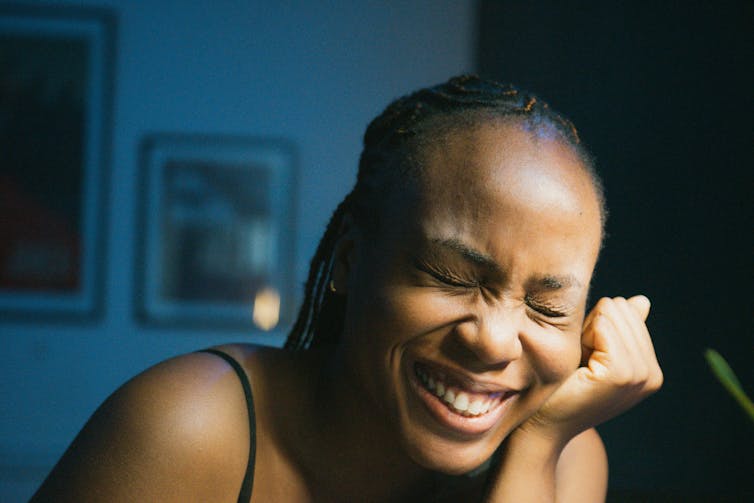
The social role of blushing
People blush when they are feeling highly self-conscious, which is generally brought on by unwanted social attention.
So even though the “fight-or-flight” system is involved, blushing isn’t about preparing for danger. Instead, scientists think it evolved as a social signal, a way of showing others that we recognise a mistake or feel embarrassed.
This can actually help build trust, because people often see blushing as a sign of honesty or sincerity – especially as it’s involuntary. Blushing can signal a non-verbal apology for a social misstep that can help to maintain social bonds after a transgression.
Different emotions can make us blush – but the mechanism is the same: increasing blood flow to the face and making us feel hot.
The difference is that blushing in anger, for example, comes from arousal and frustration, while blushing from embarrassment comes from self-awareness and social emotion.
People will blush for different reasons. For example, one study found children with social anxiety blushed from embarrassment when given exaggerated praise, compared to moderate praise or none.
In a follow-up study, the researchers found kids found who scored highly for narcissism – meaning they had an exaggerated sense of self-importance, wanted admiration and lacked empathy – blushed only when given moderate praise. Researchers suggested this was because the praise given didn’t match how well the child believed they performed.
Who’s most likely to blush?
Women and younger people blush more. This may explain why it is often associated with youth, vitality and fertility.
People with social anxiety are also more likely to blush.
But as we age and have more life experience, we tend to blush less. This may indicate we are more familiar with social norms – or less bothered if we transgress them.
People with facial erythema (persistent facial redness) are often mistakenly seen as blushing. But this condition can have a variety of causes, including rosacea, allergic contact dermatitis, reactions to medication and lupus erythematosus (a chronic autoimmune disease).
Animals can blush too
Some primates have pale facial skin that can blush, such as Japanese macaques and bald uakaris.
For mandrills, another kind of primate, blushing plays an important role in fertility. Females have a dark face when young and after giving birth. But their faces become bright red during the follicular phase of their menstrual cycle, advertising their fertility.
When male mandrills are in the presence of fertile females, their faces become redder as they produce more testosterone.
Human make-up trends may be evoking similar fertility and attraction rituals, whether consciously or unconsciously.
For example, TikTok and Instagram are awash with people “addicted” to blush using hashtags such as #Blushaholics and #BlushBlindness. Heavy blush is also popularly worn by K-Pop bands – and not only female groups.
When to get help for blushing
Because blushing is an involuntary reaction, you can’t stop a blush once it’s coming on.
However, if you have a blush that lasts more than a few days, is accompanied by pain, or is distressing to you due to cosmetic concerns, talk to your GP or health professional.
Cognitive behavioural therapy (a kind of talk therapy that helps reframe unhelpful thoughts and behaviours) may benefit people who blush because of social anxiety.
In rare cases where the cause is an overactive sympathetic nervous system, surgery may be recommended. There are two kinds: a sympathectomy removes a piece of the sympathetic chain – a long chain of nerve fibres running beside the spine; while a sympathicotomy cuts this chain near the second rib, where it joins this spine.
Evidence suggests these procedures are effective and can improve quality of life for people with severe symptoms.
But for most people, blushing won’t require medical intervention. If you can get through the embarrassment, this involuntary response can be a chance to reflect on your body’s signals, and what they reveal about yourself and how you connect with the world.
Read more https://theconversation.com/why-do-we-blush-turning-red-may-have-surprising-social-benefits-267012


