

New study sheds light on the threat of ‘marine darkwaves’ to ocean life
- Written by The Conversation
Life in the ocean runs on light. It fuels photosynthesis, shapes food webs and determines where many marine species can live.
Gradually, that light is fading. Since the early 2000s, more than one-fifth of the global ocean has darkened as sediment, nutrients and organic matter increasingly cloud coastal waters – raising concern about the future of reefs, kelp forests and seagrass meadows.
Alarming as this picture is, focusing only on gradual darkening may miss the most ecologically damaging part of the story.
Our newly published study introduces the phenomenon of “marine darkwaves”: sudden, intense episodes of underwater darkness that can last from days to months and push marine ecosystems into acute stress.
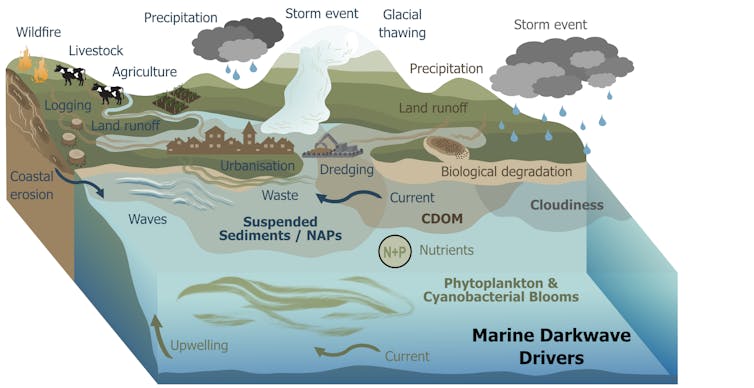
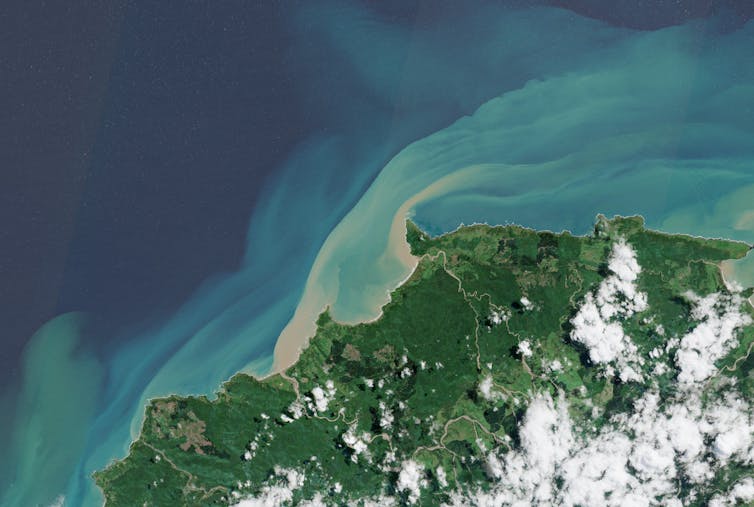
Darkness events are often triggered by storms, floods, sediment plumes or algal blooms. As with marine heatwaves, these short, intense episodes can be just as ecologically disruptive as slow, long-term trends.
Unusual underwater darkness is harmful for a range of marine ecosystems, yet the phenomenon did not have a name and definition until the marine darkwave framework was developed. Artwork of a darkened algal forest by Cassandre Villautreix, underwater picture by Leigh Tait.Why light matters underwater
When light within the ocean drops suddenly, even for a few days, marine ecosystems can suffer. Prolonged darkness can slow growth, reduce energy reserves and in severe cases lead to dieback or mortality.
Fish, sharks and marine mammals can also change their behaviour when visibility drops, altering feeding and movement patterns.
Until now, scientists have examined ways to track long-term coastal darkening but have lacked a consistent way to identify, measure and compare extreme short-term light-loss events across regions and depths.
In other words, we have known this phenomenon exists – but we haven’t had a shared language to define and describe it. With marine darkwaves, we now have an event-based framework for extreme underwater darkness.
Long-term averages are important, but they can smooth over the very events that cause the greatest ecological damage.
Just as a single marine heatwave can devastate kelp forests and coral reefs, a single marine darkwave can sharply reduce photosynthesis and disrupt ecosystems already stressed by warming, acidification and nutrient pollution.
Climate change is likely to increase the frequency and intensity of these events. Heavier rainfall, stronger storms and intensified land use all increase sediment and organic matter flowing into coastal waters, reducing water clarity and light availability.
Our framework allows identification of discrete periods when light thresholds critical for ecosystem function are crossed.
A new tool – and cause for hope
The marine darkwave framework complements existing tools used to track marine heatwaves, deoxygenation and ocean acidification.
By focusing on extremes, it provides clearer insights into acute stress on coastal ecosystems. In New Zealand particularly, this information is increasingly important for iwi (tribes) and hapū (sub-tribes), coastal communities, conservation groups and environmental managers making decisions about land use, restoration and marine protection.
Related monitoring work is already underway in parts of New Zealand, where expanded sensor networks aid in linking land-based processes to changes in underwater light, and linking these to ecological changes on coastal reefs.
Ultimately, marine darkwaves remind us that the ocean doesn’t always change slowly. Sometimes, it changes abruptly and quietly if we don’t pay attention.
There is also reason for cautious optimism. Many marine darkwaves are driven by land–sea connections, so their frequency and intensity are not inevitable.
Reducing sediment runoff through nature-based solutions, such as restoring wetlands, stabilising riverbanks, improving harvest techniques of exotic forests, and replanting native forests in vulnerable catchments can directly increase water clarity and underwater light.
Understanding marine darkwaves is not only about detecting change, but also about identifying practical pathways to protect coastal ecosystems before further darkness descends.
The authors acknowledge the contribution of Rahera Ohia, Ngāti Pūkenga, Jean Thoral, Leigh Tait and Cassandre Villautreix.


