

The Greens' climate trigger policy could become law. Experts explain how it could help cut emissions – and why we should be cautious
- Written by The Conversation
Australia’s freshly elected parliament is hashing out the details of Labor’s Climate Change Bill, which would enshrine an emissions reduction target into federal law. The Greens have the numbers to block the bill in the Senate, and are likely to seek concessions from Labor in return for their support.
Labor has already ruled out the demand to ban new coal and gas projects, saying this would devastate the economy. But Labor did not rule out another Greens policy: introducing a “climate trigger” into Australia’s environment law.
Under that proposal, future projects – such as a new mine or high-emissions industrial plant – would be assessed on the climate harms they’d potentially cause.
Let’s take a closer look at how the climate trigger would work, what it would achieve and, crucially, how it could help Australia reduce emissions.
What is the climate trigger?
To understand the proposed climate trigger, we should first outline the federal government’s role in assessing and approving new projects under Australia’s national environment law, the Environment Protection and Biodiversity Conservation (EPBC) Act.
The government’s role under the act is to assess the impacts of proposed projects on “matters of national environmental significance”. There are nine designated matters, including threatened species, wetlands of international significance and world heritage sites.

If a project is likely to have a significant impact on one of these matters, then the environmental impact assessment and approval scheme is “triggered”.
Surprisingly for legislation intended to protect the environment, climate change is not presently designated as a matter of national environmental significance. This means it’s considered only indirectly, such as how climate change impacts might harm a protected wetland or a threatened species.
The proposed climate trigger would add climate change to the list, and allow it to be dealt with head on.
In practice, this means the impacts of a proposed project on the climate would be thoroughly assessed, and then weighed in the environment minister’s final decision on whether the proposal should be approved.
Past climate trigger proposals
The climate trigger is not a new idea. In fact, when the EPBC Act was first introduced in 1999, the then environment minister sought to develop a greenhouse gas trigger. Nothing eventuated from that commitment.
In 2005, Anthony Albanese, then the shadow environment minister, introduced the Avoiding Dangerous Climate Change (Climate Change Trigger) Bill, but this also did not proceed.
 Prime Minister Anthony Albanese introduced a climate trigger bill in 2005, when he was the shadow environment minister.
AAP Image/Lukas Coch
And in 2020, the Greens introduced a climate trigger bill in the Senate which lapsed with the last parliament. The Greens’ new bill will presumably be based on this one.
Meanwhile, a major independent review of the EPBC Act in 2020 by Professor Graeme Samuel did not support a climate trigger on the basis that reducing emissions is best left to other policies and programs.
Professor Samuel did, however, say new projects should fully disclose all potential emissions as part of the assessment process. He did not elaborate on how this should be treated in approval decisions.
What could it achieve?
The climate trigger could be defined in terms of an emissions threshold, or by reference to emissions intensive activities, or by some combination of these. It could, for example, require any development likely to produce over 100,000 tonnes of carbon dioxide equivalent per year to be assessed under the act.
Coal mining and gas extraction are significant contributors to Australia’s domestic emissions.
Approving more of these projects will not only make it harder for Australia to meet its climate targets, but also, is completely contrary to the goals of the Paris Agreement. Limiting global warming to 1.5℃ above pre-industrial levels this century means putting a stop to new coal and gas.
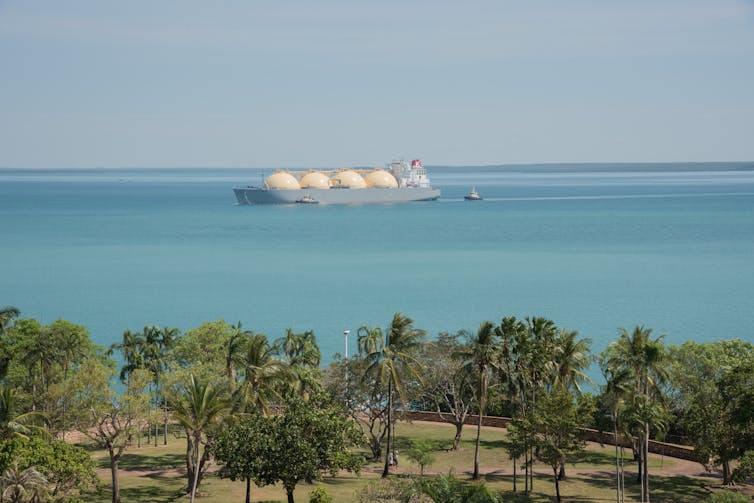
Australia is the third largest exporter of fossil fuels, behind Russia and Saudi Arabia. Our fossil fuel exports account for more than double our direct emissions. Labor’s emissions reduction targets do not address these downstream emissions.
A climate trigger would see Australia stepping up to take some responsibility for the total emissions from such fossil fuel export projects, including the emissions from burning coal and gas overseas.
 A climate trigger would see Australia taking some responsibility for the emissions that come from our fossil fuel exports.
Shutterstock
Even if new fossil fuel projects are given the go ahead, requiring proponents to disclose emissions through the assessment process would make it possible to regulate these emissions using conditions on approvals.
This would help to address significant problems with new mine proponents underestimating their emissions.
Depending on how it’s framed, a climate trigger could also play a role in regulating emissions from other sources, such as land clearing.
Why we should be cautious
There are two reasons to be cautious about what a new climate trigger might achieve.
First, a climate trigger would require only projects which trigger the act to be assessed and a decision made on approval. This is well short of demands by Greens and others to halt new fossil fuel extraction projects.
We could expect that the climate trigger would make proponents think carefully about emissions before submitting their projects for approval. But the trigger would not of itself prevent new fossil fuel projects from being proposed and approved.
If the desired result is to stop new coal and gas, there are better and more direct ways to legislate for this result.
Second, the EPBC Act is widely acknowledged as failing to protect matters of national environmental significance. It has failed to protect threatened species, world heritage sites and internationally recognised wetlands – all of which have been “triggers” under the legislation since 1999.
Adding a new climate trigger to an already failing EPBC Act may not achieve very much without additional reforms.
This includes implementing national environmental standards, as recommended by Professor Samuel, and introducing a national Environment Protection Agency to enforce the act, as promised by the Albanese government.
Arguably, proposals for a climate trigger should be dealt with as part of this larger overhaul of the act.
Read more: Labor has introduced its controversial climate bill to parliament. Here's how to give it real teeth
Still, a climate trigger could bring some real teeth to the government’s proposed Climate Change Act, whether introduced as a stand alone amendment to the EPBC Act or as part of wider reforms expected next year.
Perhaps most importantly, a climate trigger would also be a step toward Australia recognising the global harm caused by fossil fuels extracted in Australia, and the need to take greater responsibility for deciding whether these projects should be allowed to proceed.


