

What is hand, foot and mouth disease?
- Written by The Conversation
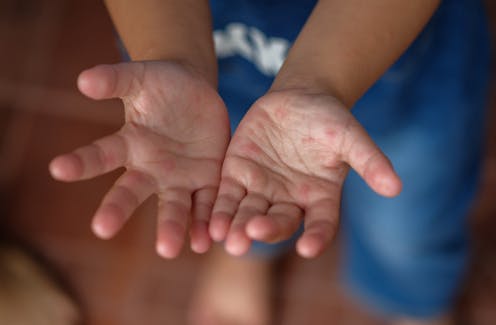
As a new parent, I’ve become acutely aware of every person in the vicinity of my daughter who has the slightest sniffle or looks vaguely unwell.
After multiple trips to emergency in her six months of life and a bout of COVID, my protective instincts are in overdrive. But I know illness is an inevitability.
A few days after a family gathering we get the call – my nephew has hand, foot and mouth disease and I should be on the look out for signs in my daughter.
So what is it?
Hand, foot and mouth disease is a highly contagious infection, most commonly caused by the coxsackie group of viruses. While highly contagious, most cases will be relatively mild.
It’s different from foot-and-mouth disease in animals which has been in the news lately.
There have also been reports of a “tomato flu” impacting children in India. Preliminary evidence suggests it’s hand, foot and mouth disease.
What are the symptoms?
The tell-tale symptoms of hand, foot and mouth disease include:
- mild fever
- small white blisters or a red rash appearing within the mouth or on the palms of the hands or the soles of the feet, which can be painful
- sore throat, often linked to the spread of blistering within the mouth and throat.
In younger children, the rash can also be apparent around the buttocks.
Fussiness, irritability and loss of appetite are often reported in children, which could be linked to the sore throat and blisters within the mouth.
Symptoms usually resolve in seven to ten days, with a low risk of complications.
How does it spread?
Hand, foot and mouth disease is highly contagious and spreads from person to person through faeces, coughing and sneezing, direct contact with blisters and contact with contaminated surfaces.
Symptoms will normally appear within three to five days of contact.
How can you prevent it?
Given the modes of transmission, the best form of prevention is good hand hygiene. Washing hands after contact with potential transmission sources greatly reduces the likelihood of contracting the disease.
Keeping children home from school and daycare is advised until the blisters have dried, the rash is gone and all other symptoms are fully resolved.
However, the virus can remain in faeces for several weeks after symptoms have cleared.
Hand, foot and mouth disease is commonly reported in day care centres and schools, with the majority of cases in children ten years and under.
So, teaching children good hand hygiene is one of the most effective tools in stopping hand, foot and mouth disease.
Hand, foot and mouth disease can also transmit to adults. In most cases, adults are largely asymptomatic but are still contagious.
How is it treated?
Most cases are relatively mild, with only paracetamol needed to help alleviate discomfort.
If blistering has spread to the mouth, the associated soreness with swallowing may lead to dehydration and needs to be monitored.
As the fluid contained inside the blisters is contagious for hand, foot and mouth, it’s important to let them dry on their own and not pop them.
In extremely rare cases, the class of viruses which cause hand, foot and mouth can impact the lining of the brain and spinal cord. Persistent fever that isn’t responding to paracetamol, rapid breathing and excessive tiredness could all be signs of severe hand, foot and mouth infection. Severe hand, foot and mouth disease will require medical assistance.
It often seems like hand, foot and mouth disease is on a march through local schools and daycare centres. Practising good hand hygiene and teaching children those same practices is the best defence against contracting and transmitting this disease.
But then I look over at my six-month-old daughter and see the delight she’s taking in sucking on her hand. This is going to be an uphill battle.
Read more https://theconversation.com/what-is-hand-foot-and-mouth-disease-189535


