

Here's why climate change isn't always to blame for extreme rainfall
- Written by The Conversation
Extreme rain and floods can trigger claims climate change is to blame. But these claims are not always well founded.
In our new paper in Nature Geoscience, we discuss what can and can’t be attributed to climate change straight after extreme rain events. We use the floods of early 2022 in eastern Australia as a case study.
We know a warmer atmosphere can hold more moisture, so it would seem reasonable to say climate change makes extreme rain events worse. But this really only applies to short, heavy downpours. For longer duration events, the climate change signal tends to be weaker and more variable.
We hope our suggestions will improve the quality of scientific statements in the media and, ultimately, increase public understanding of climate change effects on extreme weather.
Read more: On our wettest days, stormclouds can dump 30 trillion litres of water across Australia
The early 2022 Australian floods
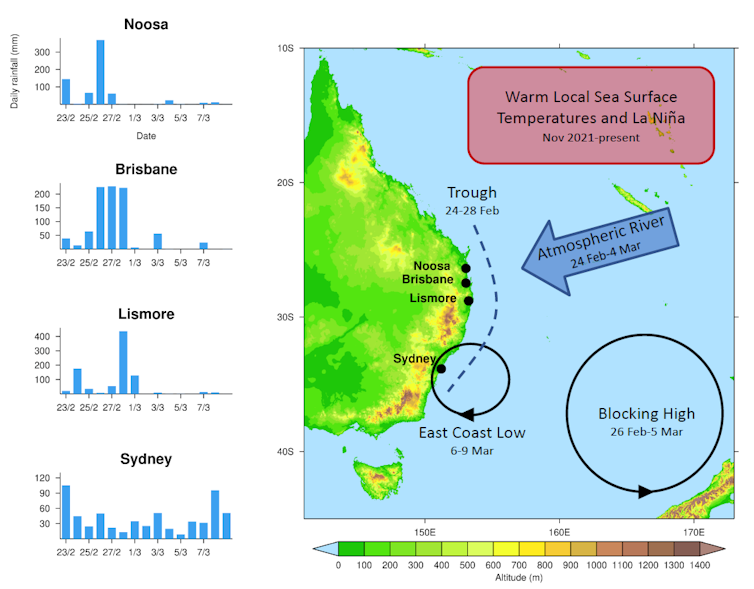
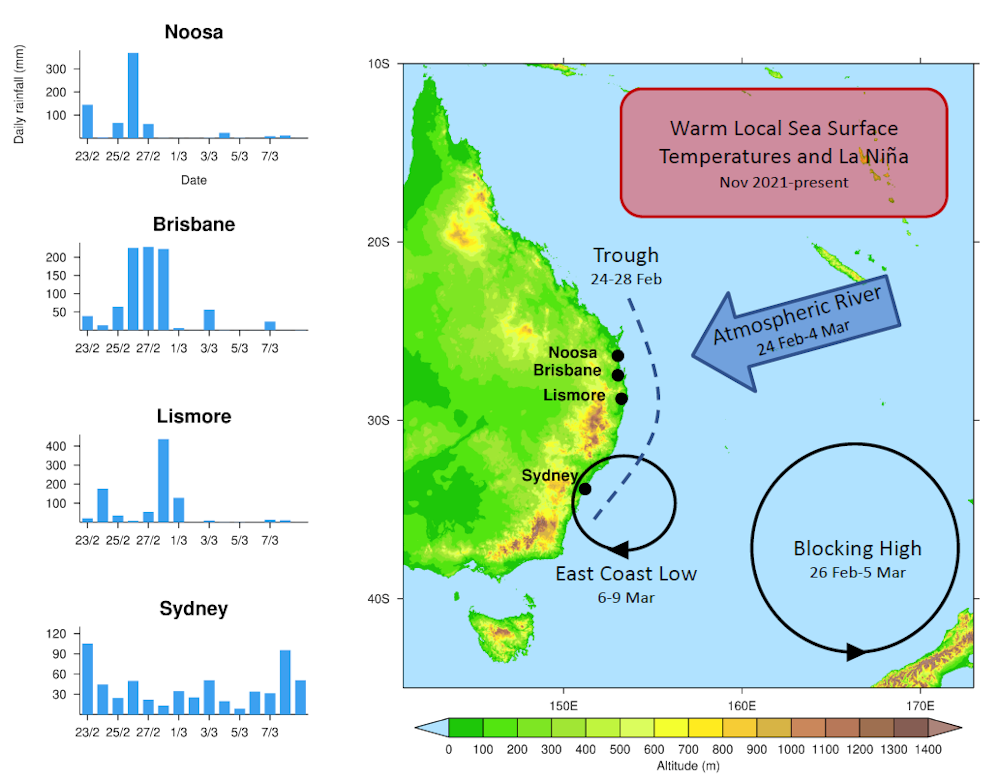
In late February and early March 2022, persistent extreme rainfall caused severe floods across much of the east coast of Australia. Many new rainfall records were set.
Brisbane recorded three consecutive days of over 200mm for the first time and Sydney experienced 16 wet days in a row, tying with a previous record. Much of southeast Queensland and northeast New South Wales had the wettest week since at least 1900.
The floods came towards the end of a third consecutive La Niña summer. Persistent heavy rainfall, associated with large-scale moisture transport in the atmosphere interacting with a trough, caused the flooding.
A blocking high pressure pattern in the Tasman Sea prevented the weather system from moving to the east. This caused the rain to continue and supported the formation of an east coast low, which brought rainfall to the greater Sydney region in early March.
The rain fell on already soaked surfaces, which worsened these floods and also set up the conditions for subsequent floods in Lismore and other parts of the east coast.
These floods occurred not long before the Australian election and led to a renewed focus on climate change action.
While we need to rapidly reduce greenhouse gas emissions to limit the damages caused by climate change, the role of climate change in this extreme rain event is unclear.
Rainfall in a warming world
There are two necessary ingredients for extreme rainfall to occur – an abundant supply of moisture and ascending air. Heavy rain can occur when moist air rises, cools and condenses. Air can be forced upwards by obstacles such as mountains and by low pressure systems.
As the atmosphere warms it can hold more moisture – about 7% more for every 1℃ of warming. This means climate change has increased the moisture-holding capacity of the atmosphere.
But the climate change effect on low pressure systems that cause air to rise varies across the planet. In some places these are becoming more common and intense. In other places they’re occurring less often.
In the prolonged heavy rainfall of February-March 2022, the duration of the weather patterns was a major factor in the flood impacts. It’s unclear how big a role climate change played.
Flooding at Murwillumbah, NSW, February-March 2022. A short film by Josh Northeast.Short downpours or longer drenching rains?
Heavy rain events that cause flash flooding and pass in minutes or hours are often limited by how much moisture is available to fall as rain. A warmer atmosphere can hold more moisture, so these short duration rain events are intensified in a warming world. Recent research shows that in Sydney there has been an increase in sub-hourly heavy rain intensity of about 40% over the last 20 years.
For persistent heavy rain that tends to cause river flooding, the limiting factor is more the positioning of weather systems and whether they stall. As a result, the climate change signal in these events tends to be weaker and more variable across the world.
What can we say after extreme events?
In the emotionally charged time following extreme events, it is important that commentators – whether they are scientists or journalists, politicians or advocates – make scientifically accurate statements on the role of climate change.
In our paper, we recommend scientists consider different lines of evidence before making statements on the role of climate change in extreme rainfall. These include examining observational trends and relevant peer-reviewed research on the climate of the area where the extreme event occurred.
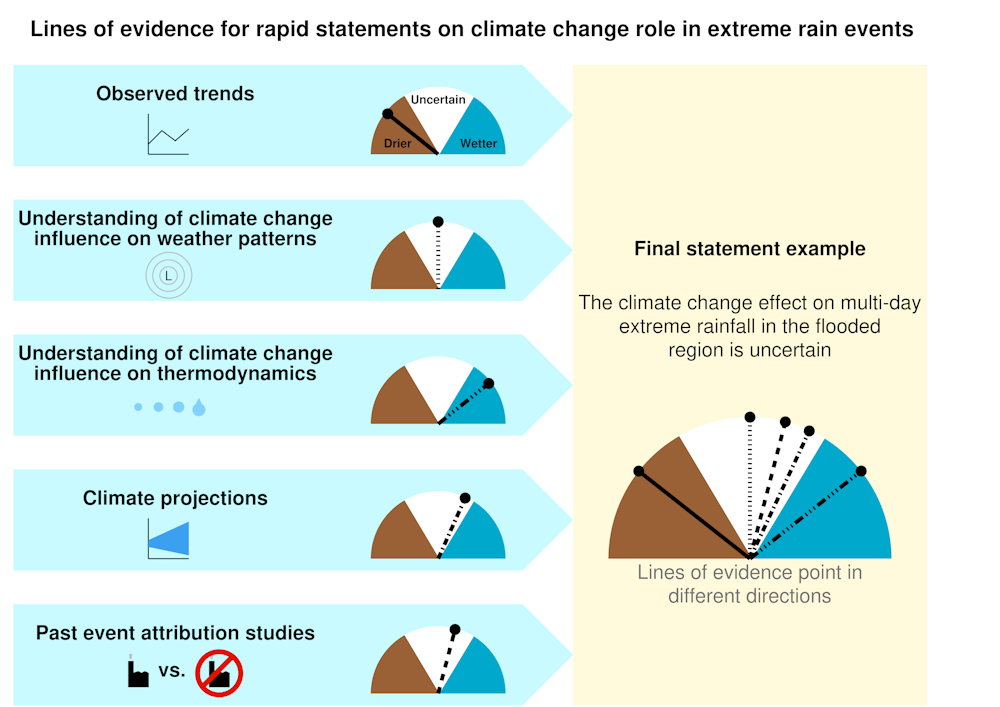 Different lines of evidence should be considered when thinking about the climate change role in extreme rain events. For the multi-day east Australian heavy rainfall in early 2022, these lines of evidence point in different directions.
Author provided. Modified from King et al. (2023)
Different lines of evidence should be considered when thinking about the climate change role in extreme rain events. For the multi-day east Australian heavy rainfall in early 2022, these lines of evidence point in different directions.
Author provided. Modified from King et al. (2023)
Robust statements on the effects of climate change on extreme events improve the public discourse and are crucial to planning for weather and climate extremes in a warming world.
The impacts of climate change are drastic enough. We don’t need to sensationalise them.
Read more: Global warming to bring record hot year by 2028 – probably our first above 1.5°C limit


