

Curious Kids: how do black holes pull in light?
- Written by The Conversation
How can a black hole pull in light when light isn’t a physical thing? – Will, age 8, Victoria

What an excellent question, Will! I too wondered about this when I started to learn the wonders of physics.
To answer this, we must first explain three things: 1) what is light, 2) what is gravity, and 3) what is a black hole?
1) What is light?
Light is just a type of energy, travelling through space. There are many different types of light we can’t physically see, but can detect and even use. For example, ultraviolet light that comes from our Sun is why you have to wear sunscreen – so the light doesn’t hurt your skin.
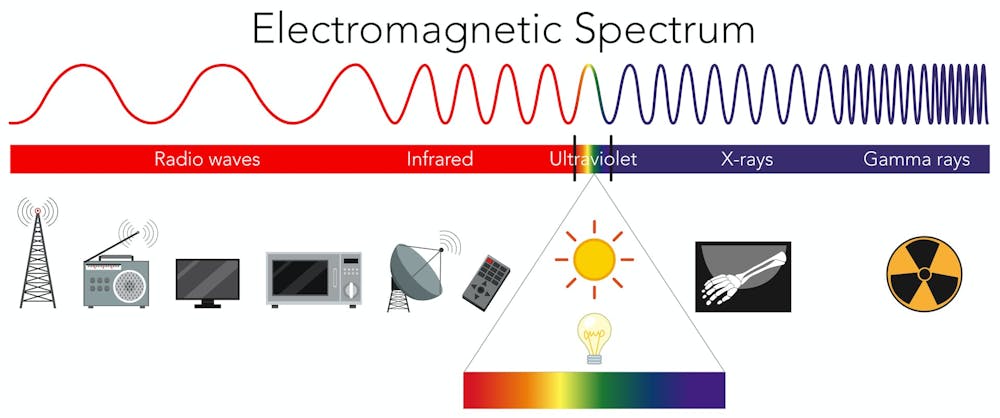
Read more: Curious Kids: can our brains sense electromagnetic waves?
It’s important for us to remember that just because light doesn’t have mass, it still is very much a physical thing in our universe, following physical laws.
The neat thing is, no matter what type of light, it all follows the same physical laws in the universe. One rule is that light always wants to travel in a straight line through space.
This is where we now need to break down gravity, and what space is made of.
2) What is gravity?
Gravity is the force that keeps us safe here on Earth. It also keeps Earth circling around (orbiting) our Sun. But what causes gravity?
Many scientists in history pondered this question, and came up with all sorts of theories. But when Albert Einstein presented his theory on general relativity in 1915, we started to really understand exactly what gravity was, and how it affects our universe.
Einstein had mathematically worked out that we exist in something called “spacetime”. You can picture this as the fabric of our universe. Like a fabric, it can bend and stretch. I like to picture space like a trampoline. When you put something heavy (like a bowling ball) in the middle of a trampoline, the fabric underneath it bends and sinks down.
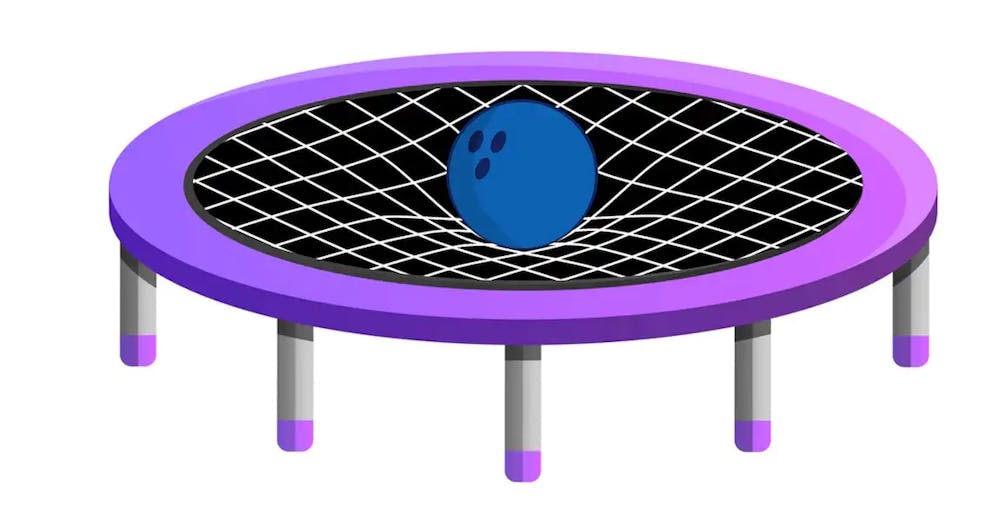 A trampoline being bent by a bowling ball is not unlike spacetime being bent by something heavy. This is how gravity works.
Sara Webb, CC BY
A trampoline being bent by a bowling ball is not unlike spacetime being bent by something heavy. This is how gravity works.
Sara Webb, CC BY
Now imagine a universe-sized trampoline, and we place our Sun on it. The dip in that trampoline represents the gravity of the Sun. And we can do this with every object that has mass.
When spacetime is bent by that mass, the lines that would normally be straight become slightly curved – you can see that in the picture below. This is most extreme around the really massive objects we call black holes.
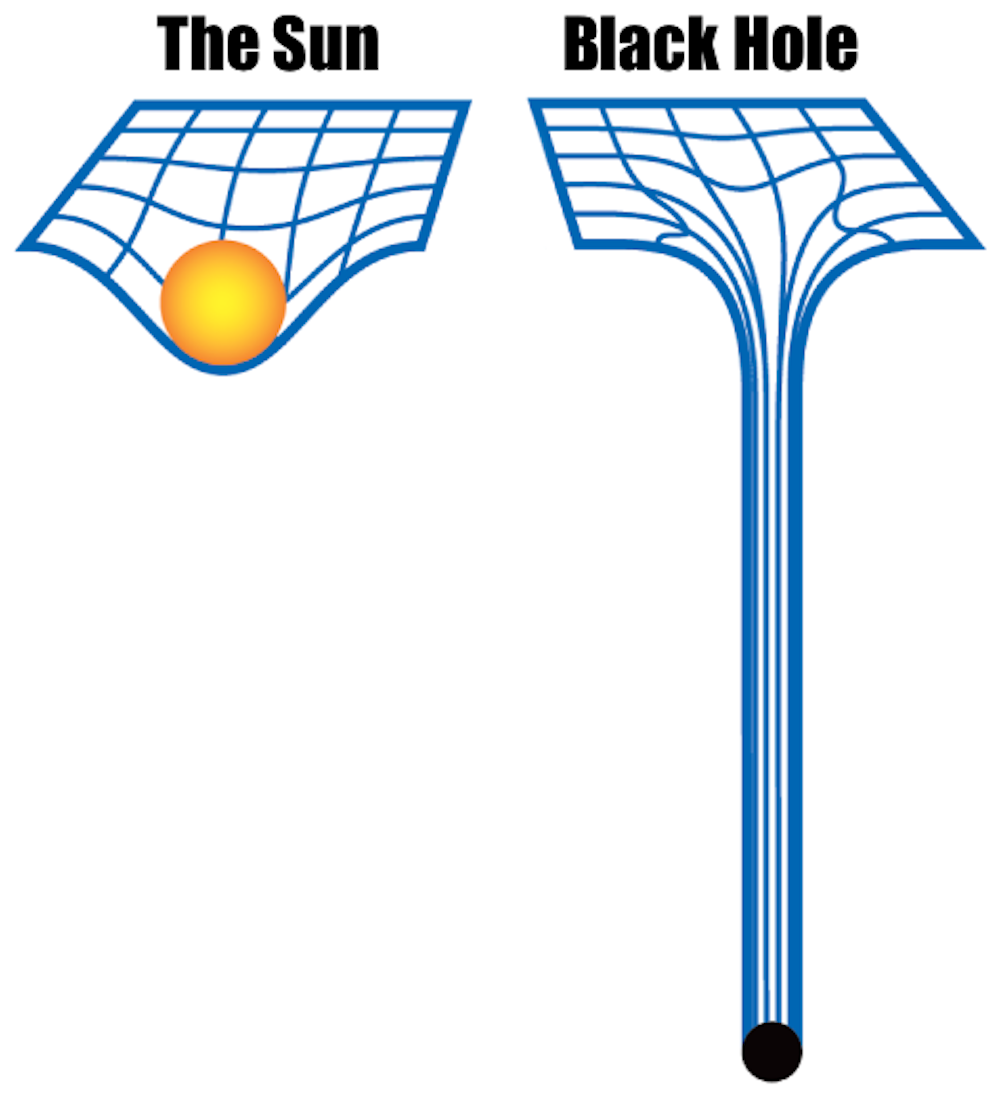 Spacetime bending around the Sun compared to a black hole. Note the lines that once would have been straight are bent and curved under the gravity.
Sara Webb/Wikimedia Commons, CC BY
Spacetime bending around the Sun compared to a black hole. Note the lines that once would have been straight are bent and curved under the gravity.
Sara Webb/Wikimedia Commons, CC BY
Read more: Curious Kids: How are planets created?
3) What is a black hole?
Black holes are, in my opinion, one of the coolest things we’ve ever discovered in the universe. Black holes are regions of space so dense, nothing can escape.
They are usually formed when very large stars get too heavy and collapse (implode) on themselves. Astronomers think all the mass in the black hole is actually squished into a single point in the middle.
Black holes get a bad reputation for eating “anything that is near them”, which is just not true. Black holes do have a distance from their centre, which we mark as the point of no return. This is called the event horizon.
But farther away from this point, light and matter can circle around a black hole for a very long time.
So how can a black hole pull in light?
Now we’ve broken down those three key things, we can answer the great question asked by Will: how can a black hole pull in light?
When light is travelling near a black hole, it is still trying to travel in a straight line. As it gets closer to the black hole where spacetime is bent, the light will follow those bends.
When light gets very close to the black hole, it can be trapped circling around and around it. That’s because the fabric of spacetime is bent to the extreme. As you’ll remember, light is indeed a physical thing and is affected by spacetime.
Possibly my favourite part about this fact is it doesn’t just apply to black holes.
Anything with enough mass can make light bend around it, even our Sun. This was how scientists first confirmed Einstein’s theory of gravity was likely correct in 1919.
Something really heavy, like a whole group of galaxies clumped together, can bend space so much, it works like a magnifying glass and shows zoomed-in pictures of the stars behind it.
Read more: Curious Kids: what are gravitational waves?
Read more https://theconversation.com/curious-kids-how-do-black-holes-pull-in-light-208848


