

NZ’s vital kelp forests are in peril from ocean warming – threatening the important species that rely on them
- Written by The Conversation
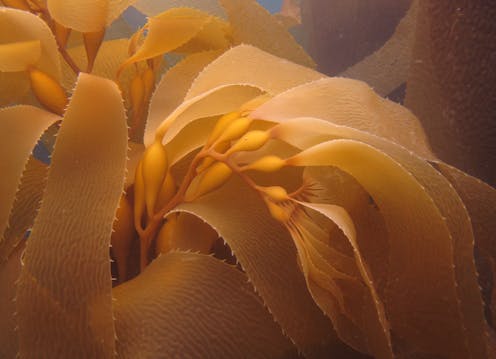
Years of almost non-stop marine heatwaves are stressing New Zealand’s kelp forests. But as we show in our new research, ongoing ocean warming is only one of several threats to these unique and important coastal seaweed ecosystems.
Many seaweed species are sensitive to changes in the ocean’s acidity and coastal “darkening” – changes in colour and clarity – is forcing some to retreat to shallower waters. All these stress factors combined place these crucial habitats in peril, with consequences for all species that depend on them.
New Zealand has the ninth longest coastline in the world (at about 15,000 kilometres). This is almost twice the length of Australia’s great southern reef, which has been valued at AUS$10 billion annually.
No equivalent valuation has been calculated for New Zealand’s seaweed-dominated rocky reefs, but we know they provide crucial habitat for economically and culturally important species such as pāua (abalone), kina (sea urchins), rock lobster and near-shore finfish.
Our ability to predict the future impacts on these species depends on our understanding of how the coastal habitats they require are changing.
Rising heat and dimming light
New Zealand’s seaweed ecosystems include canopy-forming large brown algae as well as several understorey species. Driven by rising ocean temperatures, more frequent, intense and longer marine heatwaves already place these kelp forests under thermal stress.
We predict that marine heatwaves will change the range and basic physiology of many seaweed species, removing sensitive ones from the northern edges of their ranges and slowing growth rates of most.
Seaweeds require sunlight to photosynthesise and grow. But increasingly frequent erosion events from extreme weather like cyclone Gabrielle raise sediment levels in coastal seawater, leading to coastal darkening.
Sediment running off the land, made worse by storm events, has already lowered photosynthetic rates of seaweeds in several regions. New Zealand’s geologically young landmass is eroding rapidly in some areas and research shows seaweed communities are creeping further up the reef into shallow waters. They can no longer survive in deeper reefs because of low light.
This darkening will intensify if we don’t halt erosion and remediate lands. The effects of sedimentation have likely already limited the distribution of some seaweeds and will continue to do so in future.
When the sea becomes more acidic
Ocean acidification, which makes seawater more acidic because of the excess carbon dioxide it is absorbing, threatens the ability of calcareous seaweeds to grow. It puts the survival of sensitive coralline algae (the pink algae covering coastal rocky reefs) at risk, slowing their growth and ability to spread to new space.
These red seaweeds form skeletons made of calcium carbonate and represent the seaweed group most sensitive to ocean acidification. Within coralline algae, some species are more sensitive than others.
In New Zealand, coralline algae provide important surfaces for larval settlement of many species, including pāua and kina. Whether the species of coralline algae that provide vital settlement substrates are sensitive or robust to ocean acidification remains unknown.
Ecological impacts on seaweed ecosystems
Seaweed communities provide enormous benefits to New Zealand. They provide food and habitat for several marine invertebrates and finfish species of both cultural and commercial value, including pāua, kina, moki, snapper, rocklobster, blue cod and butterfish.
If seaweed ecosystems are altered, these species will experience changes in food supply and habitat availability.
Giant kelp (Macrocystis pyrifera) and bull kelp (Durvillaea spp.) are important habitat formers and food suppliers for other species. But they are also extremely sensitive to the impacts of temperature stress.
Marine heatwaves and ongoing ocean warming likely threaten them throughout their ranges, especially at their northern limit.
Shifting population ranges and invasions
Warming oceans also facilitate the spread of Australian long-spined urchins (Centrostephanus rodgersii) which will threaten seaweed communities in northern New Zealand.
Populations of this warm-water species have already expanded in some parts of New Zealand, similar to Tasmania where it invaded during the 1950s and caused widespread “urchin barrens” where the urchins graze through kelp beds, leaving few seaweeds.
Read more: Sea urchins have invaded Tasmania and Victoria, but we can’t work out what to do with them
New Zealand is home to around 1,100 species of seaweeds. Many are poorly documented and with unknown ranges.
The combined effects of climate change will likely result in the extinction of some species with very narrow ranges. This is especially true for species that are sensitive to changes in light or temperature and currently live near the edges of their physiological limits.
To add to all of this, we don’t know how the impacts of the invasive caulerpa seaweeds Caulerpa brachypus and Caulerpa parvifolia will interact with climate change.
The degradation of coastal ecosystems is another reminder that we must move to eliminate the use of fossil fuels, as well as limiting overfishing and sedimentation.
There is potential to breed high-temperature, low-light and low-pH resistant strains of major species to help restore these ecosystems in the future, but we need strategic government investment in integrated coastal management and climate adaptation to save them in the first place.


