

Playful whales can use seaweed as a hat – or exfoliant. This kelping behaviour is more common than we realised
- Written by The Conversation
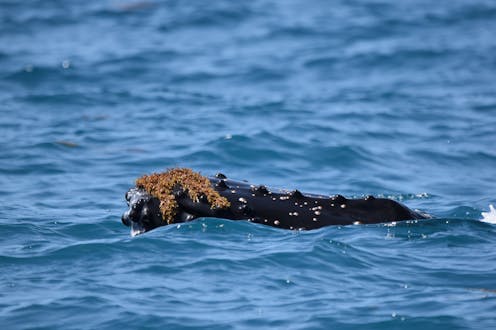
If you’re a whale, there’s often not too much to see out in deeper water. Perhaps that’s why so many whales get playful with kelp and other seaweed.
Once might have been chance. But we’ve collected over 100 examples on social media of whales playing with seaweed, known as “kelping”. It’s not just one species – gray whales, southern and northern right whales, and humpback whales all do it.
To date, there’s far more social media and news reports on whale play with seaweed than scientific literature. A 2011 study in New South Wales described these interactions as playful behaviour. Other researchers have documented instances of whales moving logs through the water in Colombia or interacting with jellyfish on the United States east coast.
Our new research compiles data from over 100 kelping events captured on social media. From this, we deduced two things. First, it is playful. And second, it’s likely to have a useful component, such as using the seaweed to scratch an itch (hard without hands), brush off baby barnacles, or flick away whale lice – parasites that drive the whales mad.
How do whales find kelp – and what do they do with it?
Sightings of this behaviour tend to occur in regions where kelp is abundant. That’s no surprise. Kelp is a very strong seaweed and can take the punishment a whale can dish out.
Most videos and photos capturing this behaviour are of humpback whales as they migrate. That’s also not surprising. Humpback whales are one of the most common species. They tend to migrate closer to shore. And they do more activities at the surface compared to other baleen whales, which is why beach goers and whale-watching boats most often see humpback whales.
Until now, kelp play has been documented in Australia, the United States and Canada. But this is likely due to the fact these regions have a larger number of people who do whale-watching and who use social media platforms to share their observations.
Drones have given us a new way of studying this behaviour. In several drone videos, we can see humpback whales actively seeking out seaweed. These interactions aren’t just fleeting – whales can play with it or use it for up to an hour.
Read more: Whale of a tale? The stories about whales helping tackle climate change are overblown
During kelping, whales tend to lift the seaweed up and balance it on their rostrum, their flat upper head.
They also seem willing to share their kelp patches with other whales, engaging in cooperative behaviours such as rolling, lifting and balancing the seaweed together.
So is it play? In part, yes. When animal researchers look at a behaviour, it has to meet three criteria to be play. First, it seems voluntary and enjoyable. Second, it’s different to more serious behaviours. It can be exaggerated or deliberately incomplete. And third, the animals don’t seem stressed or hungry, suggesting they’re in good health. Kelping meets all three of these.
For animals, play has long-term benefits such as boosting their coordination and movement skills. Balancing seaweed may also be stimulating for the whales, as their rostrums have fine hair follicles. It could even be ticklish.
Kelping might be more than just play
Toying with seaweed might have benefits other than just being fun. Some of us enjoy seaweed wraps at a spa or as a facial mask.
It might be the same for whales. Some seaweed species have been found to reduce bacterial growth, which could be useful for whales, as their skin hosts a range of viruses and bacteria. Whales have to constantly shed their skin to keep on top of bacterial growth.
There are other possibilities. Pushing through seaweed again and again could also help whales rid themselves of unwanted guests, such as the early life stages of barnacles and sea lice. Because whales are so large, many species of invertebrates hitch a lift or spend their lives on these creatures – and often to the whale’s annoyance. Grey whales off the coast of Mexico have repeatedly approached humans for help in keeping down numbers of itchy whale lice, which are actually more closely related to a shrimp or small crab than to lice.
Humpback whale interacting with kelp in CaliforniaSimilar self-medication behaviour has been reported in other marine mammals, such as when Red Sea dolphins rub over sponges and soft corals to, scientists believe, help skin conditions. Even green sea turtles use corals and rocks to clean their carapace.
As more of us use drones and better cameras, we’re likely to see more whale kelping caught on camera and shared in the coming years.
Kelping shows us how much we still have to learn even about well-studied whale species such as the humpback whale. The gentle and inquisitive nature of these whales shines through when we see them play or use seaweed. Even now, there are many mysteries yet to be uncovered in nature.


