News Daily

The Times

Australia

  • Written by The Conversation
Australia's emissions must decline more steeply to reach climate commitment: OECD

Australia’s emissions need to decline “on a much steeper trajectory” if it is to meet its declared commitment of a 43% reduction by 2030 and net zero by 2050, the Organisation of Economic Co-operation and Development says.

In its report on Australia, released as part of its Going For Growth update on Tuesday, the OECD recommends Australia develop

a national, integrated long-term emissions reduction strategy with clear goals and corresponding policy settings to achieve climate targets.

The OECD also suggests broadening the scope of Australia’s so-called Safeguard Mechanism, which at present regulates the emissions of Australia’s 215 biggest polluting facilities.

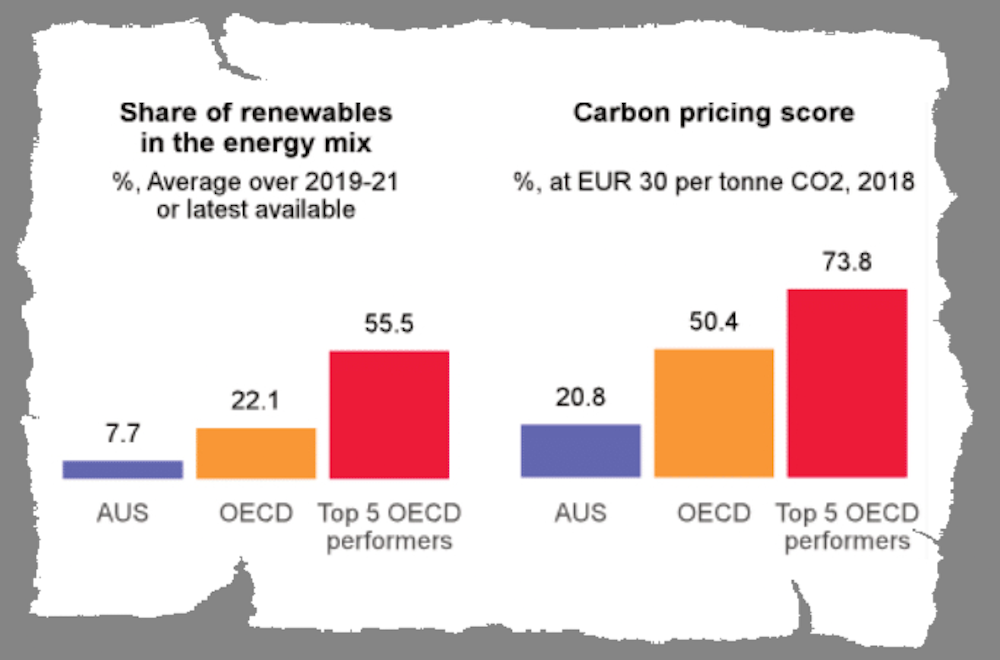
It awards Australia a score on carbon pricing well below the OECD average and even further below that of the top OECD performers.

It says the share of renewables in Australia’s energy supply averaged only 7.7% between 2019 and 2021, compared to an average of 22.1% for OECD members, and 55.5% for the top performers.
OECD, Going for Growth 2023 The OECD is a forum of 38 mainly high-income countries, including Australia, that describe themselves as committed to democracy and market economies. The report is critical of Australia’s performance on a number of other fronts, including income support for the unemployed, job market flexibility and the recognition of trade qualifications. It says Australia’s JobSeeker unemployment benefit remains among the lowest in the OECD and below the relative poverty line when compared to the wages available from work. The Albanese government has increased the rate of JobSeeker in the May budget. The report recommends the government consider “further increasing” it. Declining productivity, declining competitiveness The OECD finds signs of “reduced competitive intensity” in product markets, as well as falling labour mobility. “Productivity growth has also slowed down.” It says about one in five workers needs a licence to do their work, raising economic costs, and calls for automatic mutual recognition of licenses across states. Access to fast broadband is low compared to other developed countries, and the take-up of digital technologies by businesses can be improved, the report says. The OECD also draws attention the “large” gaps in economic and wellbeing measures between Indigenous and other Australians. It recommends the government “embed the Productivity Commission Indigenous Evaluation Strategy in the policy design and evaluation process of all Australian government agencies”. Workforce transformation needed for 2050 target Meanwhile, a report prepared by Jobs and Skills Australia entitled The Clean Energy Generation: workforce needs for a net zero economy says the government’s 2050 net-zero emissions target will require a transformation in the workforce that is “substantial but not unprecedented”. “Like the post-war industrial transformation and the digital transformation of the late twentieth century, a new generation of workers will be required, both from existing energy sectors and through new pathways into clean energy. New jobs, skills, qualifications, training pathways, technologies and industries will emerge over the next 30 years,” the report says. “Australia will need to consider the full range of levers across the education, training, migration, procurement, and workplace relations systems to ensure a sustainable and equitable path towards net zero.” Treasurer’s response to OECD Treasurer Jim Chalmers said the Albanese government was acting on the areas identified in the OECD report. Its policies were “focused on maximising the opportunities of the energy transformation, embracing digitalisation and new technology and investing in our people and their skills so that we can build a more productive, prosperous and dynamic economy”. “We’re securing faster progress towards decarbonisation through our safeguard mechanism, over $40 billion of investment in the energy transformation, our sustainable finance strategy, and establishing a new Net Zero authority to train workers and prepare communities for new opportunities here,” Chalmers said.

Read more https://theconversation.com/australias-emissions-must-decline-more-steeply-to-reach-climate-commitment-oecd-214851

Calm Marketing: Why You Don’t Need Flash to Win Online

There is a growing trend happening across websites, social platforms and digital storefronts, and it goes by the name calm marketing. Rather than shouting for attention with flashing banners, countdown timers and aggressive pop ups, calm marketing invites people to... Read more

Australian Off Road Caravans: What Makes Them Different from Standard Touring Vans?

Australian off-road caravans are designed for travellers who want to go beyond sealed highways and established caravan parks. A standard touring caravan is perfect for bitumen roads and conventional holiday routes. On the other hand, off-road models are built with... Read more

Why Compact Designs of Caravan Travel Transform Short Getaways

A caravan makes exploring Australia more flexible. For many Australians, a compact and practical setup makes short breaks easier, more comfortable and far more spontaneous. The layout inside significantly impacts how comfortable, organised and enjoyable your travels become.  Travellers often compare... Read more

7 Situations Where GPR Scanning Can Prevent Costly Construction Mistakes

Construction projects often rely on accurate information before excavation, drilling, coring or demolition begins. While plans, utility records and visual inspections provide valuable guidance, they don't always reveal what's hidden beneath the surface. Unknown utilities, reinforcement, voids or buried structures... Read more

Key Terms to Review Before Signing a Business Lease

A business lease can be a large financial commitment, and the terms buried in the fine print can affect your operation for years. It can be tempting to skim past the legal detail once you’ve found premises you like, but... Read more

When Should You Speak to Bankruptcy Lawyers About Debt Problems?

Debt problems rarely appear without warning, yet many people wait far longer than they should before seeking legal advice about their situation. By the time the decision is made to consult with bankruptcy lawyers, the available options are often more... Read more