

Even platypuses aren't safe from bushfires – a new DNA study tracks their disappearance
- Written by The Conversation
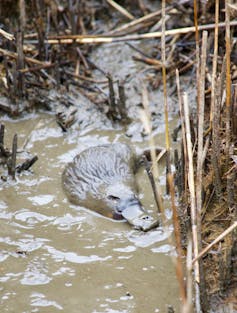
When the Black Summer bushfires swept across eastern Australia in 2019–20, thousands of animal species lived in the path of these megafires.
You’d be forgiven for thinking water-dwelling animals like platypuses were spared. Surely animals living in rivers and streams would be safe?
But our new research, published today in Biological Conservation, reveals platypuses are disappearing from waterways after fire.
We took water samples from streams and rivers across south-eastern Australia to test for platypus DNA. We found platypuses were less likely to be found in burnt catchment areas, six months after fire. But the species returned after 18 months. We hope our findings will support conservation actions in the event of future bushfires.
Read more: A platypus can glow green and hunt prey with electricity – but it can't climb dams to find a mate
An evolutionary masterpiece
Platypuses are much loved and unique to Australia. As monotremes, they lay eggs. They’re one of only five species of mammals that does – the other four are echidnas.
They have webbed feet for swimming. And they have electroreceptors in their bills to help them find food in rivers and streams.
But they can be hard to find. It’s difficult to determine whether there’s a platypus living in a particular waterway.
Monitoring allows us to detect changes in populations or communities. There may be gradual changes over time, or rapid responses to a big disturbance, such as a fire. Quick, efficient methods are vital for surveying species that occupy large areas.

DNA detective work
Platypuses are found in waterways throughout the east coast of Australia, from Cooktown in northern Queensland to Tasmania.
Little is known about how platypuses and other aquatic or semi-aquatic animals respond to fire. Ideally we would have good data on species before and after a fire, to draw comparisons. But that is rare.
Other research shows aquatic invertebrates (animals with no backbones) and fish can be harmed by bushfire, especially when rain follows fire.
Bushfires burn and kill the vegetation that stabilises the soil around rivers or streams. When rain follows fire, a lot of ash, soil and other debris can be washed into waterways. The water chemistry might change or there might be big increases in sediment, which makes the river or stream inhospitable for invertebrates and fish.
As platypuses feed on aquatic invertebrates such as yabbies, these flow on effects of fire could also impact them.
 Platypus feed on invertebrates, which find debris- and sediment-filled waterways inhospitable.
Shutterstock
Platypus feed on invertebrates, which find debris- and sediment-filled waterways inhospitable.
Shutterstock
Just as people leave traces behind as they move through the environment (such as fingerprints, hair and skin cells), so do animals. These traces contain genetic material that can be analysed to identify the likely source.
We used this “environmental DNA” to detect where platypuses were present across the study area.
We sampled 118 rivers and creeks across Victoria, New South Wales and the Australian Capital Territory a year before the Black Summer fires, for a project on platypus distribution. This was fortuitous, because it provided a baseline for us to determine the effects of the unprecedented fires.
We took more environmental DNA samples from the same 118 sites at six months after the megafires, and also 12–18 months post-fire, giving us three data points for the same rivers and creeks.
The sampling sites were spread across burnt and unburnt areas, giving us unaffected (control) sites to use as a comparison.
What we found
Six months after the megafires, platypuses were less likely to be living at sites that experienced fire. But the difference between burnt and unburnt sites was negligible after 18 months.
The combination of severe fire and rainfall minimised the chance of finding platypuses living at a site.
Watersheds are areas of land that drain rainwater into local streams and creeks. We used the watershed of each site to calculate the area over which rain would drain to a site.
We also looked at what proportion of the watershed was burnt at high severity, as we thought this would increase the chance of destabilised soils and ash being washed into the waterways. We classified high severity fire as fire which removed all of the leaves from trees and burnt grasslands or pasture.
From our work, we predicted that sites where the watershed had at least 25% of its area burnt at high severity, and also experienced high rainfall, had a less than 10% chance of platypuses occupying those sites.
 The ash and debris from bushfires can get washed into nearby waterways, affecting the water chemistry and wildlife habitat.
Shutterstock
The ash and debris from bushfires can get washed into nearby waterways, affecting the water chemistry and wildlife habitat.
Shutterstock
Understanding change
Climate change is predicted to lead to more frequent, severe and extensive bushfires in south-eastern Australia, as well as to more extreme rainfall events.
Our work adds to our understanding of how just one species could be harmed by the climate crisis.
We need these types of systematic surveys to provide baselines and monitor how populations and communities are changing. Monitoring will also help us respond more efficiently to major disturbances like the Black Summer bushfires, where, for many species, there wasn’t enough data to inform the initial emergency conservation response.
We would like to acknowledge Josh Griffiths, Reid Tingley and Luke Collins for their invaluable contribution to this work and Jaana Dielenberg for early discussions about this article.
Read more: Worried about heat and fire this summer? Here's how to prepare


