

26 years ago, Howard chose fossil fuels over the Pacific. What will Albanese choose?
- Written by The Conversation
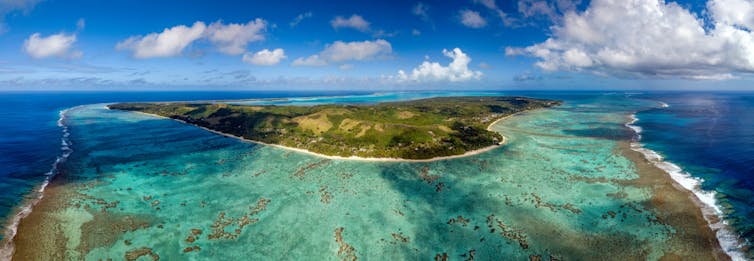
Hot on the heels of trips to Washington and Beijing, Prime Minister Anthony Albanese is now in the Cook Islands for the Pacific Island Forum. There, he will aim to strengthen relations with Pacific countries and reaffirm Australia’s place as a security partner of choice.
But to do that, he’ll have to repair a historic split from when former prime minister John Howard met with Pacific leaders on the same island, Aitutaki, a quarter of a century ago to defend his choice to expand Australia’s fossil fuel industries.
Pacific leaders see climate change as by far their greatest security threat. Sea level rise, stronger cyclones, marine heatwaves and ocean acidification pose existential threats. They will ask Albanese to support a regional declaration for a phaseout of fossil fuels.
What will happen on the atoll? We could see history repeat – Pacific outrage, Australian intransigence. Or we could see a better outcome, if Albanese signals Australia is at last ready to move away from fossil fuels.
A split in Aitutaki
When a scientific consensus on global warming emerged in the mid-1980s, Australia’s initial response was aligned with Pacific nations. In fact, they called for industrialised countries to immediately cut greenhouse gas emissions in a joint statement in 1990.
Pacific island nations suggested Australia’s national target – to cut emissions by 20% by 2005 – should be binding for all developed countries.
That brief window soon closed. Under sustained lobbying from the fossil fuel industry, the Australian government came to see global climate action as a threat to economic prosperity.
At the first Conference of Parties (COP1) to the UN climate convention in 1995, Australia’s negotiators argued for a weaker emissions target because our economy was more fossil fuel dependent than comparable nations. This positioning in the UN climate talks was further entrenched when Howard came to power in 1996.
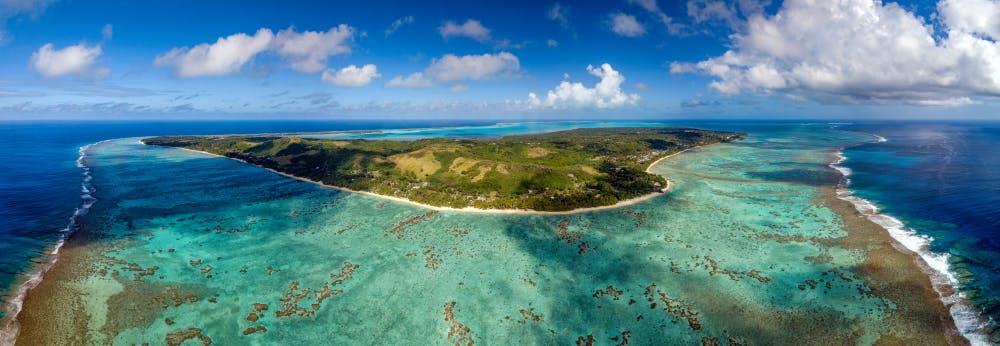
Differences with island nations came to a head at the 1997 South Pacific Forum, when island leaders tried to persuade Howard to support their calls for globally binding emissions cuts ahead of Kyoto Protocol negotiations later that year. Discussions in Aitutaki turned bitter and ran into overtime in the airport lounge.
Howard was not moved. At the Kyoto negotiations, Australia sought and won its own clause, allowing it to actually increase emissions, and expand its fossil fuel industries.
Afterwards, the Cook Islands prime minister Geoffrey Henry described Australia’s approach as a “self-serving” attempt to protect coal and energy intensive industries. Tuvalu prime minister Bikenibau Paeniu told regional media that “Australia dominates us so much in this region, for once we would have liked to have got some respect”.
For his part, Howard dismissed concerns that climate change and sea-level rise could threaten island states as “exaggerated” and “apocalyptic”.
Australia’s decision has rankled ever since.
Could we see Australia repair the rift?
For his part, Albanese has said he wants to repair the climate rift. At last year’s forum, he joined island leaders to declare a Pacific climate emergency. Australia is bidding to host the UN climate talks in 2026 in partnership with Pacific island countries, a move island leaders have formally welcomed. But it’s also clear Pacific countries want him to support a regional declaration to phase out fossil fuels.
Pacific governments have not been sitting still. This year, a group of Pacific governments called for a fossil-fuel-free Pacific. Island countries want to establish a new Pacific Energy Commissioner to oversee the region’s energy transition.
Pacific countries are also campaigning for a global Fossil Fuel Non-Proliferation Treaty which would oversee the end of fossil fuel expansion. These goals will be put to leaders again this week – including Albanese.
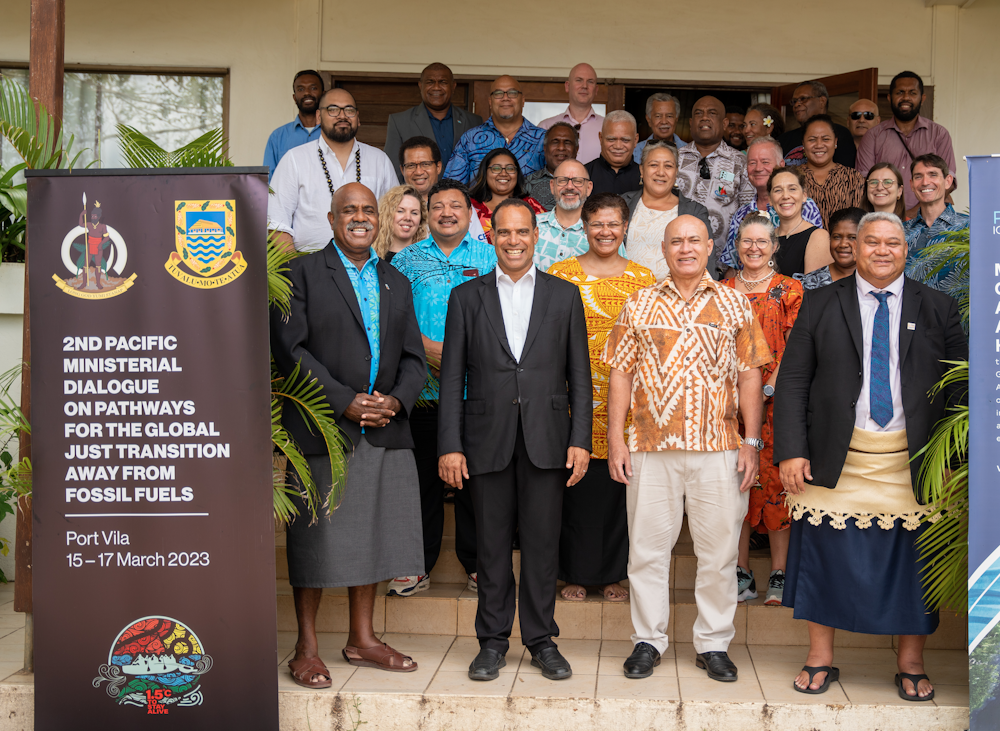 When Pacific ministers met in Vanuatu’s Port Vila in March, they emerged with calls for a fossil-fuel-free Pacific.
Voyager Pacific Studios, CC BY-ND
When Pacific ministers met in Vanuatu’s Port Vila in March, they emerged with calls for a fossil-fuel-free Pacific.
Voyager Pacific Studios, CC BY-ND
There are signs Albanese will arrive with new climate finance in hand, including A$50 million for the global Green Climate Fund and funds for a regional Pacific Resilience Facility. Support to tackle rising climate adaptation costs will be welcomed, but it won’t be enough for Pacific leaders. What they want to see is their regionally powerful neighbour actually stop adding fuel to the fire.
Vanuatu’s climate minister Ralph Regenvanu says Pacific nations need genuine allies who will make substantive commitments to move away from coal, oil and gas.
No stopping the global energy transition
It’s not just Pacific nations calling on Australia to commit to a fossil fuel phase-out. Germany’s international climate envoy Jennifer Morgan is headed to this week’s forum to call on Australia to support the European Union push for a phase-out at next month’s UN COP28 climate talks in Dubai.
Ambassador Morgan this week said:
we have to not only phase out fossil fuels, we need to stop building new infrastructure for fossil fuels, because they will become stranded assets. We need to be working on a just transition for workers and building up new industries.
She has a point. The International Energy Agency last week released its annual World Energy Outlook, which found global deployment of renewable energy technologies is rapidly overtaking fossil fuel projects, and demand for fossil fuels is likely to peak before 2030.
Australia’s economic interests are shifting as the world economy heads toward net zero emissions. Gas and coal aren’t the only valuable things underneath Australian dirt – we’ve got a wealth of critical minerals vital to the clean energy transition.
Governments have no choice but to plan for the inevitable decline of fossil fuels and smooth the transition to clean energy industries such as battery manufacturing and green hydrogen and ammonia.
The sooner Australia gets on with the transition away from fossil fuels, the sooner we will be embraced by the rest of the Pacific family.
Read more: Both the US and Australia are adamant the Pacific "matters". But only one is really moving the dial


