

Praiseworthy makes history: Alexis Wright is the first author to win the Miles Franklin and the Stella Prize for one book
- Written by The Conversation
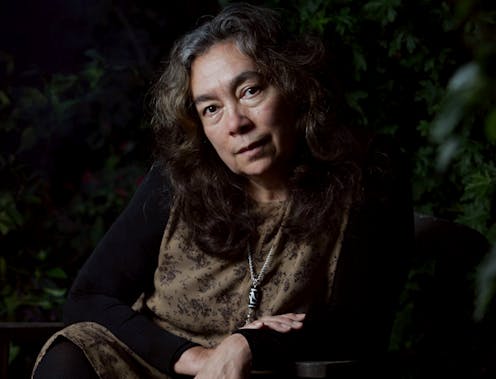
Waanyi writer Alexis Wright and her magnum opus Praiseworthy have made history by winning this year’s Miles Franklin Literary Award. She’s now the first writer to win the Miles Franklin and The Stella Prize (both national literary prizes) for the same work.
It’s also her second Miles Franklin win: her first was for Carpentaria in 2007.
Wright becomes one of a handful of authors since the Miles Franklin was first awarded in 1957 to win the prize more than once, and only the fourth woman to do so. Other multiple winners have included Patrick White (the award’s first winner), Michelle de Kretser, Kim Scott, Thea Astley, Jessica Anderson and Tim Winton.

 Cause Man Steel, also known as Planet or Widespread, understands the havoc being wreaked by the climate crisis. He also understands help from the government is not coming. So after dreaming of a donkey – one perfect grey donkey among the millions of the continent’s feral donkeys – he makes his own plan. He will establish a donkey conglomerate for the people of Praiseworthy, “who would become millionaires”.
His epic quest, more akin to Cervantes’ Don Quixote than Homer’s Odysseus, takes him and his old Ford Falcon (which stands in as his mighty steed or trusty boat) on an adventure.
His wife, Dance, is uninterested in the hordes of donkeys deposited in town for her to look after. She leaves them in the cemetery, where she lives on contested Native Title land. Instead, she turns to “the wisdom of moths, of butterflies, while hatching her own plan to escape from the known world”. Dance dreams of moving to China to escape what is around her.
Aboriginal Sovereignty, the eldest child of Chance and Dance, is 17 and the hope of the community. He is “named for young hope and all that emotion-laden charged asset language of the modern day”. When he attempts suicide, the potential loss of Aboriginal Sovereignty – the young man, but also sovereignty itself – both breaks the town and brings it together.
Tommyhawk, the second child, is eight. Through his arc, Wright explores what may happen to children exposed to the politicking, dog whistling and race baiting in the Australian media. His story recalls the ongoing consequences of the 2007 Northern Territory National Emergency Response (the “Intervention”), as well as so many other instances in contemporary media.
Tommyhawk accuses a family member of rape because “he listened to all of the news about how the government and all the white commentators in the country – except those Aboriginal people – were saying how bad Aboriginal communities were to live in because of the paedophiles”. He wants to leave Praiseworthy and live in the “white palace of Federal Parliament” with “the golden-hair Minister for Aboriginal Affairs whom he had been watching faithfully on ABC News”.
Around these central characters, the people of Praiseworthy showcase the best and basest impulses of humanity. Wright explores questions of assimilation, especially through the Mayor Ice Pick (who is slowly turning white), who wants to keep a “tidy town” to make Canberra happy.
All times are happening at once
Time is not linear in Praiseworthy: all times are happening at once. Wright’s approach to story, as Jane Gleeson-White noted in The Conversation’s review, “involves all times and realities, the ancient and the new, the story within story within story – all interconnected, all unresolved”.
Wright has written and spoken of the influence of Mexican writer Carlos Fuentes on her writing, especially his observation that “no time has ever been resolved”. This may well be difficult for readers, but continuing to read – learning to read in a new way – may be the most rewarding thing a reader can do this year.
Praiseworthy is also available as an audiobook. Given the strong tradition of oral storytelling and lyricism of Wright’s work, listening to Djok woman Jacqui Katona narrate Praiseworthy is an experience in itself.
Praiseworthy is for all readers. But interpretations and understandings of the work will differ depending on who is reading. I am a white reader, and my interpretation – and this review – is born of that perspective.
First Nations readers will surely uncover and understand more than I have. I encourage readers to muse on First Nations authored reviews by Claire G. Coleman, Declan Fry and Mykaela Saunders.


