

See Earth’s seasons in all their complexity in a new animated map
- Written by The Conversation
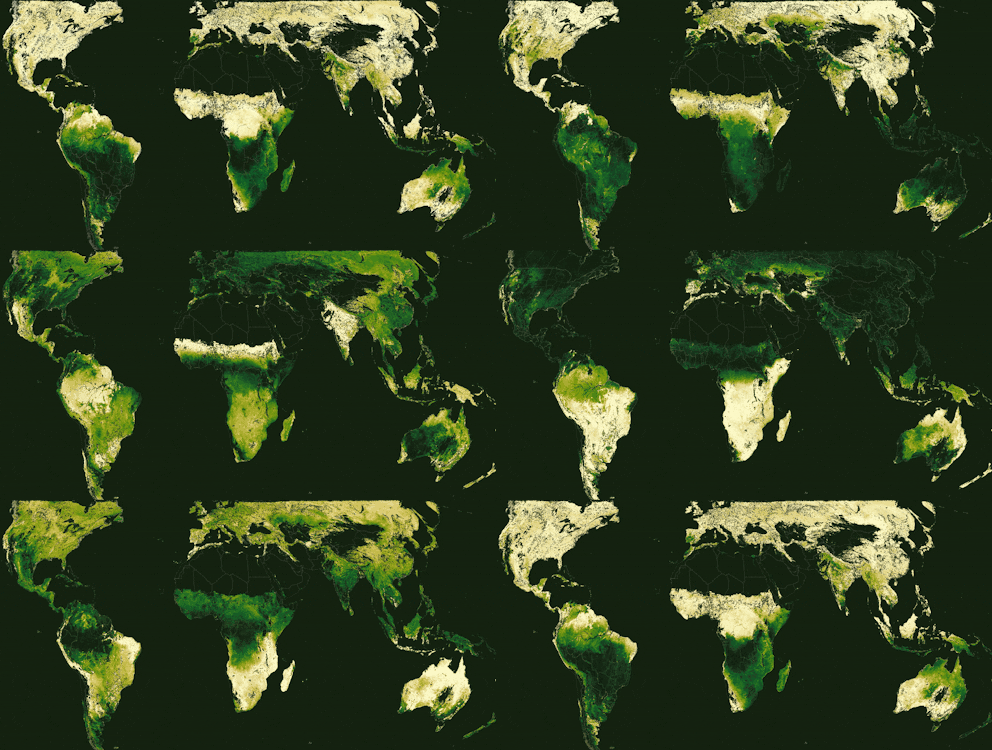
The annual clock of the seasons – winter, spring, summer, autumn – is often taken as a given. But our new study in Nature, using a new approach for observing seasonal growth cycles from satellites, shows that this notion is far too simple.
We present an unprecedented and intimate portrait of the seasonal cycles of Earth’s land-based ecosystems. This reveals “hotspots” of seasonal asynchrony around the world – regions where the timing of seasonal cycles can be out of sync between nearby locations.
We then show these differences in timing can have surprising ecological, evolutionary, and even economic consequences.
Watching the seasons from space
The seasons set the rhythm of life. Living things, including humans, adjust the timing of their annual activities to exploit resources and conditions that fluctuate through the year.
The study of this timing, known as “phenology”, is an age-old form of human observation of nature. But today, we can also watch phenology from space.
With decades-long archives of satellite imagery, we can use computing to better understand seasonal cycles of plant growth. However, methods for doing this are often based on the assumption of simple seasonal cycles and distinct growing seasons.
This works well in much of Europe, North America and other high-latitude places with strong winters. However, this method can struggle in the tropics and in arid regions. Here, satellite-based estimates of plant growth can vary subtly throughout the year, without clear-cut growing seasons.
Surprising patterns
By applying a new analysis to 20 years of satellite imagery, we made a better map of the timing of plant growth cycles around the globe. Alongside expected patterns, such as delayed spring at higher latitudes and altitudes, we saw more surprising ones too.
Average seasonal cycles of plant growth around the world. Each pixel varies from its minimum (tan) to its maximum (dark green) throughout the year.One surprising pattern happens across Earth’s five Mediterranean climate regions, where winters are mild and wet and summers are hot and dry. These include California, Chile, South Africa, southern Australia, and the Mediterranean itself.
These regions all share a “double peak” seasonal pattern, previously documented in California, because forest growth cycles tend to peak roughly two months later than other ecosystems. They also show stark differences in the timing of plant growth from their neighbouring drylands, where summer precipitation is more common.
Spotting hotspots
This complex mix of seasonal activity patterns explains one major finding of our work: the Mediterranean climates and their neighbouring drylands are hotspots of out-of-sync seasonal activity. In other words, they are regions where the seasonal cycles of nearby places can have dramatically different timing.
Consider, for example, the marked difference between Phoenix, Arizona (which has similar amounts of winter and summer rainfall) and Tucson only 160 km away (where most rainfall comes from the summer monsoon).

Other global hotspots occur mostly in tropical mountains. The intricate patterns of out-of-sync seasons we observe there may relate to the complex ways in which mountains can influence airflow, dictating local patterns of seasonal rainfall and cloud. These phenomena are still poorly understood, but may be fundamental to the distribution of species in these regions of exceptional biodiversity.
Seasonality and biodiversity
Identifying global regions where seasonal patterns are out of sync was the original motivation for our work. And our finding that they overlap with many of Earth’s biodiversity hotspots – places with large numbers of plant and animal species – may not be a coincidence.
In these regions, because seasonal cycles of plant growth can be out of sync between nearby places, the seasonal availability of resources may be out of sync, too. This would affect the seasonal reproductive cycles of many species, and the ecological and evolutionary consequences could be profound.
One such consequence is that populations with out-of-sync reproductive cycles would be less likely to interbreed. As a result, these populations would be expected to diverge genetically, and perhaps eventually even split into different species.
If this happened to even a small percentage of species at any given time, then over the long haul these regions would produce large amounts of biodiversity.
Back down to Earth
We don’t yet know whether this has really been happening. But our work takes the first steps towards finding out.
We show that, for a wide range of plant and animal species, our satellite-based map predicts stark on-ground differences in the timing of plant flowering and in genetic relatedness between nearby populations.
Our map even predicts the complex geography of coffee harvests in Colombia. Here, coffee farms separated by a day’s drive over the mountains can have reproductive cycles as out of sync as if they were a hemisphere apart.
Understanding seasonal patterns in space and time isn’t just important for evolutionary biology. It is also fundamental to understanding the ecology of animal movement, the consequences of climate change for species and ecosystems, and even the geography of agriculture and other forms of human activity.
Want to know more? You can explore our results in more detail with this interactive online map, which we also include below.
Read more https://theconversation.com/see-earths-seasons-in-all-their-complexity-in-a-new-animated-map-262935


