

‘Extremely hostile’: Trump lashes China over trade controls but there may be a silver lining
- Written by The Conversation
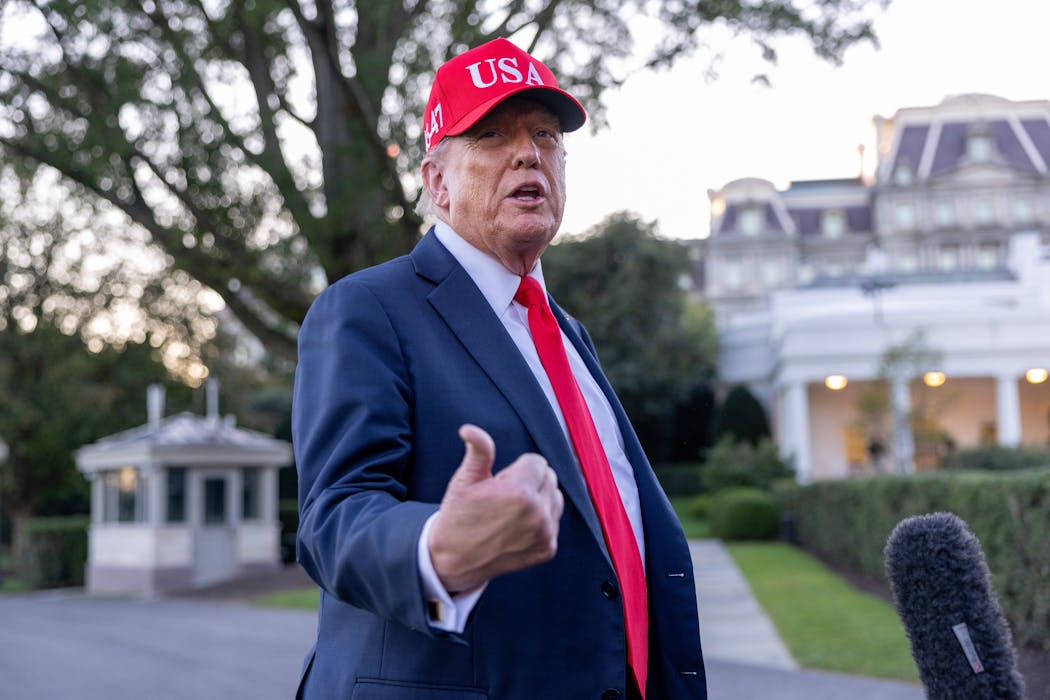
The trade dispute between the United States and China has resumed. US President Donald Trump lashed out at the weekend at Beijing’s planned tightening of restrictions over crucial rare-earth minerals.
In response, Trump has threatened 100% tariffs on Chinese imports.
But with the higher tariff rate not due to start until November 1, and the Chinese controls on December 1, there is still time for negotiation.
This is no longer a trade dispute; it has escalated into a race for control over supply chains, and the rules that govern global trade.
For Australia, this provides an opening to build capacity at home in minerals refining and rare-earths processing. But we also need to keep access to our biggest market – China.
A long-running battle
Since 2018, the US has sought to choke off China’s access to semiconductors and chipmaking tools by restricting exports.
China last week tightened its export controls on rare earth minerals that are essential for the technology, automotive and defence industries. Foreign companies now need permission to export products that derive as little as 0.1% of their value from China-sourced rare earths.
Rare earths are essential to many modern technologies. They enable high-performance magnets for EVs and wind turbines, lasers in advanced weapons, and the polishing of semiconductor wafers. An F-35 fighter jet contains about 417 kilograms of rare earths.
By targeting inputs rather than finished goods, China extends its reach across production lines in any foreign factories that use Chinese rare earths in chips (including AI), automotive, defence and consumer electronics.
Who holds the upper hand: chips or rare earths?
The US plan is simple: control the key tools and software for making top-end semiconductor chips so China can’t move as fast on cutting-edge technology.
Under that pressure, China is filling the gaps. It’s far more self-sufficient in chips than ten years ago. It now makes more of its own tools and software, and produces “good-enough” chips for cars, factories and gadgets to withstand US sanctions.
Rare earths aren’t literally “rare”; their value lies in complex, costly and polluting separation and purification processes. China has cornered the industry, helped by industry policies and subsidies. China accounts for 60–70% of all mining and more than 90% of rare earths refining.
Its dominance reflects decades-long investment, scale and an early willingness to bear heavy environmental costs. Building a China-free supply chain will take years, even if Western countries can coordinate smoothly.
A window for Australia?
Australia is seen as a potential beneficiary. As Prime Minister Anthony Albanese prepares to meet Trump on October 20 in Washington, many argue the rare-earths clash offers a diplomatic opening.
Trade Minister Don Farrell says Australia is a reliable supplier that can “provide alternatives to the rest of the world”. Australia’s ambassador to the US, Kevin Rudd, has made the same case.
The logic seems compelling: leverage Australia’s mineral wealth for strategic gain with its closest security partner. But that narrative is simplistic. It risks drifting from industrial and economic reality.
The first hard truth is that Australia has the resources, but doesn’t control the market. It is a top-five producer of 14 minerals, including lithium, cobalt and rare earths, yet it doesn’t dominate any of them. Australia’s strength is in mining and extraction, rather than processing.
Here lies the strategic paradox: Australia ships the majority of its minerals to China for processing that turns ore into high-purity metals and chemicals. Building alternative, China-free supply chains to reduce US reliance on China would decouple Australia from its main customer for raw materials.
Demand from the defence sector is not enough. The US Department of Defense accounts for less than 5% of global demand for most critical minerals.
The real driver is the heavy demand from clean energy and advanced technology, including EVs, batteries and solar. China commands those markets, creating a closed-loop ecosystem that pulls in Australia’s materials and exports finished goods. Recreating that integrated system in five to ten years, after Beijing spent decades building it, is wishful thinking.
There will be no simple winner
The US restrictions on chips and the Chinese controls over rare earths are twin levers in the contest between two great powers. Each wants to lead in technology – and to set the rules over global supply chains.
We’ve entered a period where control of a few key inputs, tools and routes gives countries leverage. Each side is probing those “chokepoints” in the other’s supply chains for technology and materials – and using them as weapons. In the latest stand-off, Trump has floated export controls on Boeing parts to China. Chinese airlines are major Boeing customers, so any parts disruption would hit China’s aviation sector hard.
There will be no simple winner. Countries and firms are being pulled into two parallel systems: one centred on US chip expertise, the other on China’s materials power. This is not a clean break. It will be messier, costlier and less efficient, where political risk often outweighs commercial logic.
The question for Australia is not how fast it can build, but how well it balances security aims with market realities.


