

Surf group found safe after days at sea in Indonesia. A sea survival expert on what it takes to survive being lost at sea
- Written by The Conversation
News that four Australians and two Indonesian crew members have been found alive after going missing on Sunday from a boat trip off the coast of Aceh in Indonesia has made headlines around the world.
The group, which was on a surfing trip, was found “bobbing around on their surfboards”, according to media reports quoting the father of one of the Australian surfers.
Our research in the Extreme Environments Laboratory at the University of Portsmouth focuses on how humans survive and respond to adverse environments.
So what does it take to survive such gruelling conditions?
Read more: 'Your first emotion is panic': rips cause many beach drownings, but we can learn from the survivors
A hierarchy of survival
There is an established hierarchy of survival.
Without air you only survive for a matter of minutes. Without sufficient warmth you only survive hours. Without sufficient drinking water you can survive up to six or seven days in a maritime environment. Without food you can survive 40–60 days.
So, those who survive more than a few hours are almost always in warm air or water.
Because you can eventually cool even in water that is relatively warm, you are better off out of the water than in it. Being on top of a surfboard is a step in the right direction.
Read more: Why is extreme 'frontier travel' booming despite the risks?
Dealing with dehydration
When the water and air are warm, the primary problem is dehydration.
Death due to dehydration occurs when you lose about 15–20% of your body weight in fluid.
Even at 5% dehydration you can get headaches, become irritable and feel lightheaded. At 10% you may be dizzy, feel faint, have a rapid pulse and rapid shallow breathing. Thereafter, hallucinations and delirium are common.
To survive longer than six or seven days, when dehydration is your major threat, you must do two important things.
First, try to find fresh water. The absolute minimum you need to find is 110–220 millilitres a day, although 400mL per day is safer.
If you were prepared, you may have taken water with you as you embarked on your survival voyage.
If you are lucky, it might rain and you may be able to collect some rainwater in suitable, uncontaminated containers.
Surfers are unlikely to have devices such as a solar still or a reverse osmosis pump available to purify water for safe drinking. But other sources of useful fluids include fish “lymph” squeezed from the flesh of fish. This has about the same salt concentration as human body fluid (0.9%), so is only helpful if you are very dehydrated.
Fish eyes, spinal fluid and turtle blood can also help when desperate.
What you must not do, despite what becomes an overwhelming urge, is drink the seawater that surrounds you.
Seawater has an average salt concentration of 3.5%, so drinking it adds to the salt load of the body.
You should also not drink urine in this situation, because it will also contribute to salt building up in your body.
Conserving fluids
The second important factor is to conserve body fluid.
The body of a 75kg person contains nearly 50 litres of water, and in a survival situation where dehydration is your greatest threat, conserving this water is crucial.
The body helps. With a body fluid loss of 1% of body weight and consequent decrease in blood volume and increase in salt concentration, the body increases the production of the anti-diuretic hormone that lowers urine production by the kidneys.
You can provoke this response by drinking nothing in the first 24 hours of a survival voyage.
At the same time, it is important to do as little as possible. Try to minimise heat production by the body, which will mean less sweating.
So “bobbing around” on a surfboard is better than paddling it and getting hot and sweaty.
Normally, you would seek or make shade on your survival craft and rest during the hottest parts of the day. This is not possible on a surfboard, but periodic wetting from waves may keep you cool and help reduce sunburn (which can impair your ability to control your body temperature) by cooling the skin and covering it periodically.
The longer-term challenge is starvation – but this is a less pressing problem than dehydration.
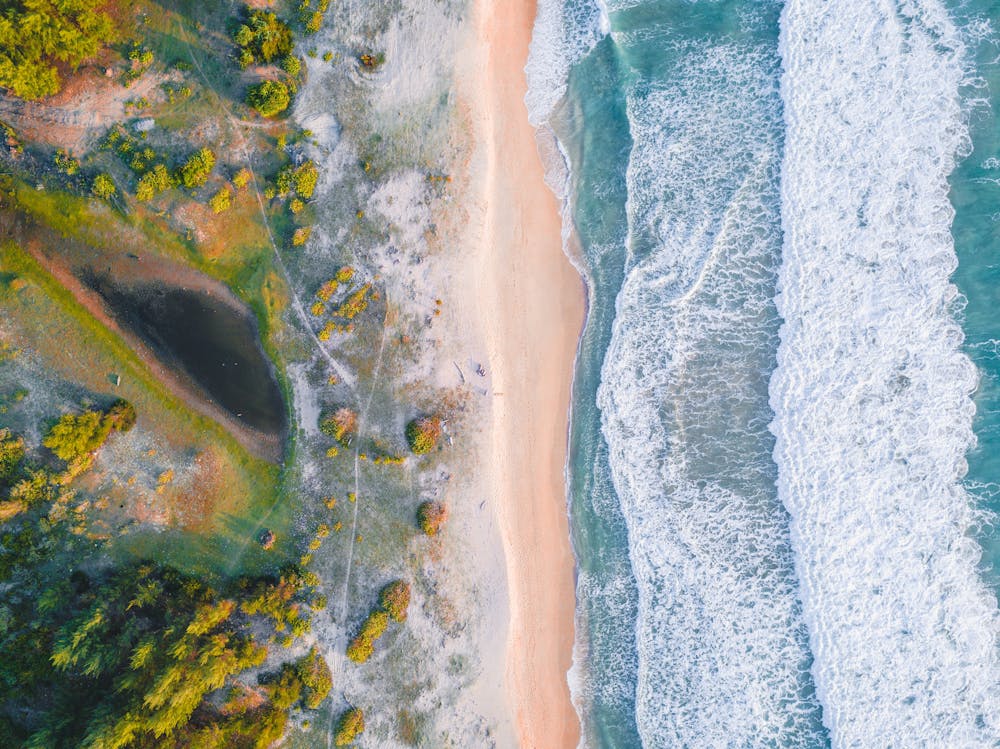 Waters off Aceh Province, Indonesia.
Unsplash
Waters off Aceh Province, Indonesia.
Unsplash
Staying calm in a crisis
Survival at sea depends on knowing how your body works and what it needs, and then doing the right things.
Experience helps. Being used to the sea means you remain more relaxed in a crisis and are less likely to become seasick (which can accelerate dehydration, impair body temperature regulation and destroy morale).
Being with others helps morale and decision-making. Young and fit people, such as many surfers, are less likely to have other health-related problems that may compromise their survival prospects.
Read more: Alone in a dark cave: what can we learn from extreme survival experiments?


