

56 million years ago, Earth underwent rapid global warming. Here’s what it did to pollinators
- Written by The Conversation
Pollinators play a vital role in fertilising flowers, which grow into seeds and fruits and underpin our agriculture. But climate change can cause a mismatch between plants and their pollinators, affecting where they live and what time of year they’re active. This has happened before.
When Earth went through rapid global warming 56 million years ago, plants from dry tropical areas expanded to new areas – and so did their animal pollinators. Our new study, published in Paleobiology today, shows this major change happened in a remarkably short timespan of just thousands of years.
Can we turn to the past to learn more about how interactions between plants and pollinators changed during climate change? That’s what we set out to learn.
A major warming event 56 million years ago
In the last 150 years, humans have raised atmospheric carbon dioxide concentrations by more than 40%. This increase in carbon dioxide has already warmed the planet by more than 1.3°C.
Current greenhouse gas concentrations and global temperature are not only unprecedented in human history but exceed anything known in the last 2.5 million years.
To understand how giant carbon emission events like ours could affect climate and life on Earth, we’ve had to go deeper into our planet’s history.
Fifty-six million years ago there was a major, sudden warming event caused by the release of a gigantic amount of carbon into the atmosphere and ocean. This event is known as the Paleocene-Eocene Thermal Maximum.
For about 5,000 years, huge amounts of carbon entered the atmosphere, likely from a combination of volcanic activity and methane release from ocean sediments. This caused Earth’s global temperature to rise by about 6°C and it stayed elevated for more than 100,000 years.
Although the initial carbon release and climate change were perhaps ten times slower than what’s happening today, they had enormous effects on Earth.
Earlier studies have shown plants and animals changed a lot during this time, especially through major shifts in where they lived. We wanted to know if pollination might also have changed during this rapid climate change.

Hunting for pollen fossils in the badlands
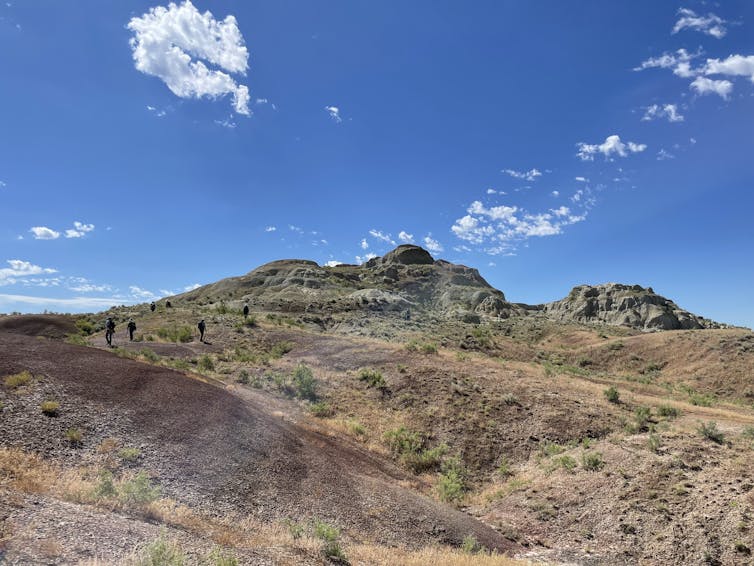
We looked at fossil pollen from the Bighorn Basin, Wyoming – a deep and wide valley in the northern Rocky Mountains in the United States, full of sedimentary rocks deposited 50 to 60 million years ago.
The widespread badlands of the modern Bighorn Basin expose remarkably fossil-rich sediments. These were laid down by ancient rivers eroding the surrounding mountains.
We studied fossil pollen because we wanted to understand changes in pollination. Pollen is invaluable for this because it is abundant, widely dispersed in air and water, and resistant to decay – easily preserved in ancient rocks.
We used three lines of evidence to investigate pollination in the fossil record:
- fossil pollen preserved in clumps
- how living plants related to the fossils are pollinated today, and
- the total variety of pollen shapes.

What did we discover?
Our findings show pollination by animals became more common during this interval of elevated temperature and carbon dioxide. Meanwhile, pollination by wind decreased.
The wind-pollinated plants included many related to deciduous broad-leaved trees still common in moist northern hemisphere temperate regions today.
By contrast, the plants pollinated by animals were related to subtropical palms, silk-cotton trees and other plants that typically grow in dry tropical climates.
The decline in wind pollination was likely due to the local extinction of populations of wind-pollinated plants that grew in the Bighorn Basin.
 A silk-cotton tree (Ceiba pentandra) relies on the wind for pollination.
Klaus Schönitzer/Wikimedia Commons, CC BY-SA
A silk-cotton tree (Ceiba pentandra) relies on the wind for pollination.
Klaus Schönitzer/Wikimedia Commons, CC BY-SA
The increase in animal-pollinated plants means that plants from regions with warmer, drier climates had spread poleward and moved into the Bighorn Basin.
Earlier studies have shown these changes in the plants of the Bighorn Basin were related to the climate being hotter and more seasonally dry than before – or after – this interval of rapid climate change.
Pollinating insects and other animals likely moved 56 million years ago along with the plants they pollinated. Their presence in the landscape helped new plant communities establish in the hot, dry climate. It may have provided invaluable resources to animals such as the earliest primates, small marsupials, and other small mammals.
A lesson for our future
What lessons does this ancient climate change event have to offer when we think about our own future?
The large carbon release at the beginning of the Paleocene-Eocene Thermal Maximum clearly resulted in major global warming. It dramatically altered ecosystems on land and in the sea.
In spite of these dramatic changes, most land species and ecological interactions seem to have survived. This is likely because the event occurred at about one-tenth the rate of current anthropogenic climate change.
The forests that returned to the region after more than 100,000 years of hot, dry climate were very similar to those that existed before. This suggests that in the absence of major extinction, forest ecosystems and their pollinators could reestablish into very similar communities even after a very long period of altered climate.
The key for the future may be keeping rates of environmental change slow enough to avoid extinctions.


